Golden Roof: The Gilded Crown of Pashupatinath
The two-tiered roof of Pashupatinath’s Main Temple — copper sheeting gilded with gold, rising to a golden pinnacle called the gajur — is the single most recognizable image of the entire complex, and, in recent years, has also become one of its most closely audited: a 2021 government-funded regilding project put roughly 142 kilograms of gold into the roof and sanctum, and the resulting installation was significant enough to trigger a formal anti-corruption investigation into exactly how much gold was actually used.
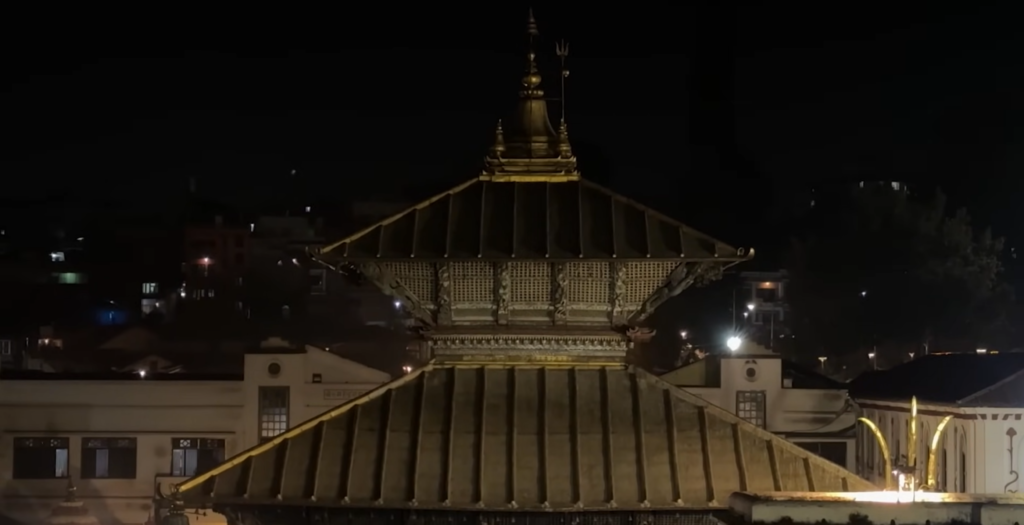
This entry looks at the roof from two angles at once — what it is architecturally and symbolically, within the wider Newar pagoda tradition, and what it has become administratively and financially, as a physical asset whose gold content has been weighed, disputed, and publicly audited within the last several years.
This entry is part of our Temple Complex guide. For the building this roof sits atop, see Main Temple; for the four silver-plated doors beneath it, see Four Doors; for the broader architectural tradition this roof belongs to, see Architecture.
Quick Answer
| Question | Answer |
|---|---|
| What is the Golden Roof? | The two-tiered, gilded copper roof of Pashupatinath’s Main Temple, topped by a golden pinnacle (gajur) |
| What is it made of? | Copper sheeting as the structural base, gilded (gold-plated) over the copper |
| How many roof tiers does it have today? | Two, though the temple’s original 17th-century form is said to have had five |
| What sits at the very top? | The gajur — a multi-part gilded finial combining a base, stem, lotus disc, and crowning pinnacle, often paired with a trident |
| How much gold is involved? | A 2021 project used an estimated 142 kg of gold across the roof, sanctum jalahari, and basaha; a subsequent government audit weighed the jalahari gold specifically at 107.468 kg |
| Who paid for the 2021 regilding? | The Government of Nepal and the Pashupati Area Development Trust (PADT) jointly, at an estimated cost of roughly Rs 1 billion |
| Did an earlier separate gold count exist? | Yes — a 2019 PADT report found the temple had accumulated about 9.3 kg of gold from devotee donations between 1962 and 2018, distinct from the 2021 government-funded project |
| Was there ever a controversy over the gold? | Yes — the Commission for the Investigation of Abuse of Authority (CIAA) investigated a complaint alleging over 10 kg of gold went missing during the 2021 jalahari installation; a subsequent official weighing found no clear evidence of foul play |
What the Golden Roof Actually Is
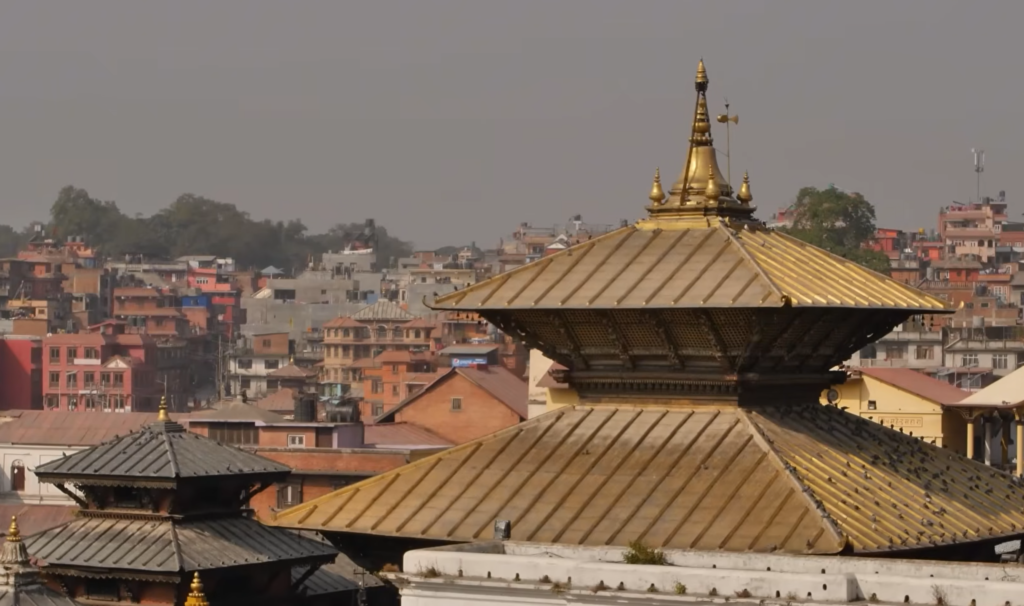
Pashupatinath’s Main Temple is built in the Nepalese pagoda style, and its roof is the architectural feature that most defines that style visually: two tiers of sloping, projecting roofing, each smaller than the one below, constructed over a copper base and gilded with gold across the visible surface. This gives the roof both its function — protecting the temple’s carved wooden structure below from Kathmandu Valley rain and sun — and its unmistakable appearance, catching sunlight across the temple’s skyline in a way few other structures in the valley can match.
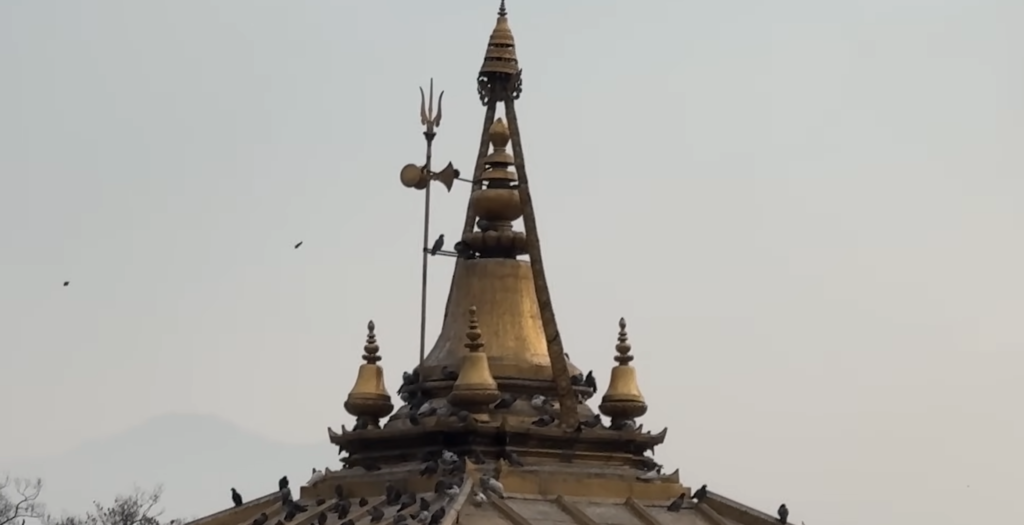
The roof is supported underneath by carved wooden struts, known locally as tundal, angled outward from the temple’s walls to bear the weight of the projecting eaves; these struts are themselves richly carved with images of deities and mythological scenes, a hallmark of Newar temple craftsmanship found throughout the Kathmandu Valley. Above the second roof tier sits the gajur, a multi-part gilded pinnacle that functions as the architectural and symbolic apex of the entire structure — discussed in more detail below. Some descriptions of the temple also note a trident (trishula), Shiva’s traditional weapon and one of his most recognizable attributes, mounted at or near the finial, reinforcing the roof’s identity as belonging specifically to a Shiva temple rather than a generic Newar pagoda form.
| Roof Component | Material | Function |
|---|---|---|
| Two roof tiers | Copper, gilded with gold | Structural weather protection; primary visual feature |
| Tundal (struts) | Carved wood | Support the projecting roof tiers; carry deity and mythological imagery |
| Gajur (pinnacle) | Gilded copper/gold | Symbolic and structural crown of the roof |
| Trident (trishula) | Metal, often gilded | Marks the temple as specifically Shaiva |
Two Tiers, Not Five: A Roof That Shrank
One detail about the Golden Roof surprises many visitors familiar with other major Kathmandu Valley pagodas, several of which — most famously the five-tiered Nyatapola Temple in Bhaktapur — display far more dramatic tiered rooflines. Pashupatinath’s Main Temple, by contrast, has only two roof tiers today, even though it is among the most important Shiva temples in South Asia. This was not always the case: sources describing the temple’s 17th-century reconstruction under King Bhupatindra Malla record that the temple originally had five pagoda roof tiers in that period, a number later reduced over subsequent renovations to the two tiers visible today.
Within the wider Newar pagoda tradition, tier count is understood as carrying its own symbolic weight — each additional tier is generally read as marking an ascent through increasingly sacred space, with the uppermost levels associated with the most rarefied spiritual significance. Two- and three-tiered pagodas are, in practice, the most common configuration across the Kathmandu Valley, making Pashupatinath’s current form architecturally typical even as its religious importance is exceptional; the correspondence between a structure’s tier count and its perceived religious rank is a general tendency within Newar architecture rather than a fixed or universal rule, and this entry does not present it as a strict formula.
The Gajur: Anatomy of the Pinnacle
The gajur — the gilded finial capping the roof — is far more than a decorative spike. In Newar architectural tradition, a gajur is typically composed of several distinct, stacked elements, each carrying its own symbolic meaning: a base representing the earth and material world, a stem symbolizing spiritual ascent, a lotus disc signifying purity and enlightenment, and a crowning pinnacle — often shaped like a flame or a parasol — representing the summit of creation or the abode of the divine. Newar religious philosophy commonly correlates these stacked layers with the five classical elements (earth, water, fire, air, and ether), treating the finished gajur as a miniature cosmological diagram mounted atop the building it crowns.
The creation of a temple gajur is itself a specialized craft, traditionally carried out by skilled Newar metalworkers — often from Tamang or Shakya artisan communities — who measure, shape, engrave, and gild the piece by hand according to proportions considered spiritually as well as structurally correct. Installing a gajur is traditionally treated as a sacred event in its own right, accompanied by a dedicated consecration ritual (a Gajur Nyaḥ Puja in domestic Newar practice, with temple installations following comparable, though grander, ceremonial procedure) in which priests bless the finished piece with flowers, incense, rice, and holy water before it is set in place. This same underlying symbolic logic — a gajur as a consecrated, cosmologically meaningful object rather than a simple ornament — applies to Pashupatinath’s own pinnacle, even though sources describing the temple’s specific gajur focus more on its gold content and history than on a detailed breakdown of its individual tiers.
Gilding: How the Roof Gets Its Gold
Gilding — applying a layer of gold over a base metal, in this case copper — has been part of Newar temple-building tradition for centuries, valued both for its visual brilliance and for gold’s practical resistance to tarnish and corrosion, which helps the roof keep its brilliance despite constant exposure to Kathmandu’s monsoon climate. Traditional Newar gilding techniques on temple metalwork typically combine hand-shaping of the copper base with a separate gold application stage, executed by artisans specializing specifically in this work rather than by the same craftsmen responsible for the underlying copper or woodwork.
Historically, temple roofs and finials across the Kathmandu Valley have required periodic regilding, since gold applied centuries ago naturally wears thin from weather exposure and, at major temples, from the sheer volume of devotee contact and ritual activity. Pashupatinath’s roof has undergone several documented rounds of renovation and regilding across its history, consistent with this broader pattern — though, as with much of the temple’s older history, precise records of exactly when each earlier regilding took place are not consistently preserved across available sources. What is far better documented is the most recent, and by far the largest and most publicly scrutinized, regilding effort: the 2021 project described in detail below.
The 2021 Regilding Project
In early 2021, the Pashupati Area Development Trust (PADT) announced a major initiative to gold-plate significant portions of the temple, timed for completion around Akshaya Tritiya — an auspicious date closely associated with gold in Hindu tradition and, not coincidentally, PADT’s own establishment anniversary. According to PADT officials at the time, the project involved gilding the temple roof itself, constructing a new gold jalahari (the ritual vessel/base structure associated with the lingam in the sanctum), and gilding the basaha — the Nandi statue positioned before the temple.
Officials estimated the total gold requirement at approximately 142 kilograms: roughly 108 kilograms allocated specifically to the jalahari, with the remaining gold used across the roof and the Nandi statue. The project’s total estimated cost ran to approximately Rs 1 billion, split between PADT’s own budget (roughly Rs 650 million) and additional government funding covering the remainder.
| 2021 Project Component | Estimated Gold Used |
|---|---|
| Jalahari (sanctum ritual base) | ~108 kg |
| Roof and Nandi (basaha) gilding, combined | Remainder of ~142 kg total |
| Total estimated cost | Approximately Rs 1 billion |
| Funding split | ~Rs 650 million from PADT; remainder from the Government of Nepal |
The Gold Audit: A Public Controversy
The scale and public funding behind the 2021 project brought an unusual level of financial scrutiny to what would, at most temples, remain an internal religious and architectural matter. In mid-2021, a formal complaint alleged that more than 10 kilograms of gold may have gone missing during the jalahari installation process — a serious allegation given that the gold involved was, at least in significant part, publicly procured. Nepal’s Commission for the Investigation of Abuse of Authority (CIAA), the country’s principal anti-corruption body, opened an investigation and took statements from numerous individuals connected to the project.
The matter culminated in a formal, closely monitored physical weighing of the jalahari’s gold, conducted with representatives from the CIAA, the Nepal Bureau of Standards and Metrology Department, the Department of Archaeology, the Department of Mines and Geology, and the Nepal Gold and Silver Dealers’ Association all present, alongside Nepal Army security personnel who cleared the temple area for the procedure and a CCTV camera recording the process. The result: the jalahari’s gold was found to weigh 107.468 kilograms — very close to, and slightly under, the roughly 107.76 kilograms officials had claimed was used, a difference PADT officials characterized as confirming there had been no embezzlement. The official conclusion of the CIAA’s broader investigation was not immediately publicized in the sources reviewed for this entry, and this entry does not claim to know its ultimate disposition beyond the weighing result itself.
This episode is worth including in an encyclopedic account of the Golden Roof not because it reflects poorly on the temple, but because it illustrates something genuinely distinctive about Pashupatinath in the present day: a religious structure whose gilding is, simultaneously, a matter of ancient sacred craft and modern public financial accountability, weighed and audited with the same rigor a government would apply to any major public infrastructure project.
Gold Beyond the 2021 Project: Devotee Offerings Over Time
The 142 kilograms associated with the 2021 government-and-PADT-funded regilding project is separate from — and should not be confused with — gold the temple has separately accumulated from ordinary devotee donations over the decades. A 2019 report compiled by a PADT-appointed panel found that the temple had collected approximately 9.276 kilograms of gold and 316 kilograms of silver in offerings between 1962 and 2018, alongside a bank balance of roughly Rs 1.29 billion — figures the panel noted excluded any earlier period, since no reliable records existed for years before 1962. This slower, devotional accumulation of gold through pilgrim offerings represents a genuinely different category from the roof and jalahari’s 2021 gilding, which was a single, large, centrally funded infrastructure project rather than an accretion of small individual gifts — though both reflect the same underlying pattern of devotees and the Nepali state alike treating gold as a fitting material for honoring Pashupatinath specifically.
The Roof in Wider Context
Pashupatinath’s Golden Roof is best understood as one instance of a broader Kathmandu Valley architectural tradition rather than a wholly unique invention. Gilded, tiered pagoda roofs distinguish some of the valley’s most celebrated religious structures, and Newar metalworking and gilding artisans have historically supplied this expertise across many temples, not exclusively Pashupatinath’s. What distinguishes Pashupatinath’s roof within that tradition is less its architectural form — a two-tiered pagoda roof is, in fact, one of the more modest configurations found in the valley — and more its scale of gold investment, its status as Nepal’s most nationally significant Shiva temple, and, in recent years, the unusual degree of public financial transparency its gilding has been subjected to.
Frequently Asked Questions
Is the Golden Roof made of solid gold?
No — the roof’s structural base is copper, with gold applied as gilding over that copper surface, a construction method consistent with Newar temple architecture generally rather than a solid-gold roof.
How many roof tiers does the Main Temple have?
Two, though sources describing the temple’s 17th-century Malla-era reconstruction record an original five-tiered roof, later reduced to the current two-tiered form through subsequent renovations.
How much gold is actually on the temple today?
Multiple figures apply to different things: roughly 142 kg was estimated for the full 2021 roof, jalahari, and Nandi-statue gilding project, with the jalahari’s gold specifically weighed afterward at 107.468 kg; separately, devotee offerings accumulated about 9.3 kg of gold between 1962 and 2018, prior to and apart from the 2021 project.
Was gold actually stolen during the 2021 project?
A complaint alleged over 10 kg might be missing, prompting a CIAA investigation; a subsequent official weighing of the jalahari’s gold found an amount very close to the claimed figure, which PADT officials cited as evidence against embezzlement, though this entry does not claim to know the investigation’s final formal conclusion.
What is the gajur, and why does it matter?
The gajur is the gilded pinnacle capping the roof, composed of stacked symbolic elements — commonly a base, stem, lotus disc, and crowning finial — representing, in Newar tradition, a kind of cosmological summary of the sacred structure it sits atop.
Who funded the most recent regilding of the roof?
The 2021 project was funded jointly by the Pashupati Area Development Trust and the Government of Nepal, at an estimated total cost of approximately Rs 1 billion.
For more direct answers, see our full FAQ section.
Where to Go Next
- Main Temple — the building this roof crowns
- Four Doors — the temple’s silver-plated entrances below the roofline
- Architecture — the broader Newar architectural tradition this roof belongs to
- Temple Layout — how the Main Temple and its roof fit within the wider complex
- Sculptures — the carved wooden and metal artistry found throughout the temple, including its struts
This entry is part of our Temple Complex guide, mapping the Pashupatinath complex — its main pagoda, golden roof, four doors, ghats, cremation grounds, shrines, and the architectural details that define it.
The Pashupatinath is an independent devotional and cultural resource. It is not the official website of the Pashupati Area Development Trust (PADT) or the Government of Nepal. For official temple notices, consult PADT directly.