Temple Layout: Mapping the Pashupatinath Complex
Pashupatinath is not a single building but a sprawling sacred landscape — a core fortified courtyard holding the golden-roofed Main Temple, surrounded by an estimated 500-plus subsidiary shrines, ashrams, and monuments, stretching along both banks of the Bagmati River across a protected area most commonly cited at roughly 246 to 264 hectares. Understanding Pashupatinath means understanding this layered geography: a tightly guarded inner sanctum at the center, rings of secondary temples and courtyards immediately around it, a chain of cremation ghats running down to the river, and, across the water, an entirely separate cluster of sacred sites — Guhyeshwari, Gorakhnath, and the Mrigasthali forest — that together make up one continuous pilgrimage landscape rather than a single stop.
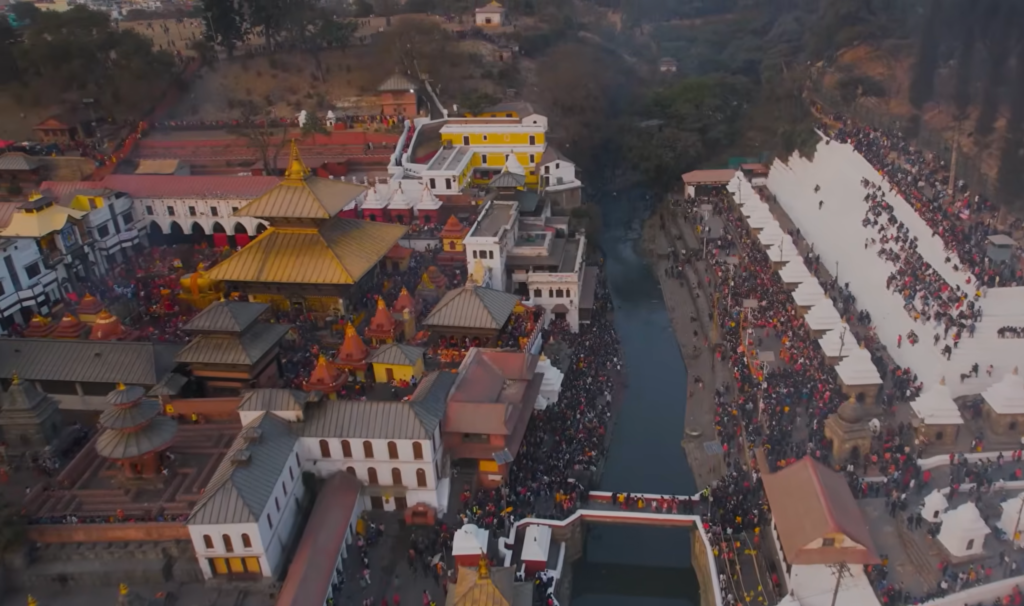
This entry is part of our Temple Complex guide. For the pagoda building at the heart of this layout, see Main Temple; for the roof and doors of that building specifically, see Golden Roof and Four Doors; for the cremation grounds along the river, see Cremation Area.
Quick Answer
| Question | Answer |
|---|---|
| What is the Temple Layout? | The overall spatial arrangement of Pashupatinath’s core temple, surrounding shrines, ghats, and sacred forest |
| How large is the protected area? | Commonly cited as roughly 246–264 hectares for the wider Pashupati Area; the immediate temple courtyard itself is far smaller, around 0.64 hectares |
| How many structures does the complex contain? | Estimates commonly cite around 500–518 temples, shrines, and monuments |
| What sits at the center? | The Main Temple, a two-tiered pagoda housing the principal Shiva Linga, inside a fortified, guarded courtyard |
| What surrounds the Main Temple’s courtyard? | Secondary shrines including Chandeshvar, Brahma Temple, Vasuki Temple, Ram Mandir, and rows of smaller Shivalayas |
| What lies across the river? | Guhyeshwari Temple, the Gorakhnath Temple, and the Mrigasthali sacred forest and deer sanctuary |
| Where are the cremation ghats? | Along the western bank of the Bagmati, immediately below and beside the Main Temple courtyard, with Arya Ghat as the most prominent |
| Who can access which zones? | The innermost Main Temple courtyard is restricted to Hindus and traditionally Buddhists of Indian/Nepali background; most surrounding zones, including the ghats and outer shrines, are open to all visitors |
Understanding Pashupatinath’s Scale
One of the most common points of confusion for first-time visitors is the sheer difference in scale between “the temple” as most people picture it and “the temple” as it actually exists on the ground. The area figures found across different sources reflect this directly: some describe the immediate temple courtyard as covering only about 0.64 hectares, while others cite the wider protected Pashupati Area — encompassing the forest, ghats, and surrounding shrine clusters on both riverbanks — at roughly 246 to 264 hectares. This is not a contradiction so much as two different answers to two different questions: how big is the fenced courtyard around the Main Temple, versus how big is the entire sacred landscape that falls under Pashupatinath’s religious and administrative authority, managed today by the Pashupati Area Development Trust (PADT).
Within that wider area, sources generally agree the complex contains several hundred individual structures — commonly cited as around 500, with one frequently repeated figure of 518 temples, shrines, ashrams, and monuments. Exact counts vary between sources, in part because “structure” can mean anything from a modest wayside Shivalaya housing a single small lingam to a substantial standalone temple with its own priesthood and festival calendar. This entry does not attempt to reconcile every count into one authoritative number; instead, it maps the complex zone by zone, which is a more useful way to actually understand how the site is organized than any single structure-count could be.
Zone One: The Main Temple Courtyard
At the physical and spiritual center of the complex sits the innermost, most tightly controlled zone: the fortified courtyard surrounding the Main Temple itself. This courtyard is entered through a substantial arched gate, and visitors passing through it first encounter a large bronze or gilded Nandi statue positioned facing the sanctum, in the traditional posture of permanent attentive darshan. The Main Temple stands roughly at the center of this open courtyard, built on a single-tier stone plinth, with its distinctive two-tiered gilded copper roof visible above the surrounding walls even from outside the courtyard itself.
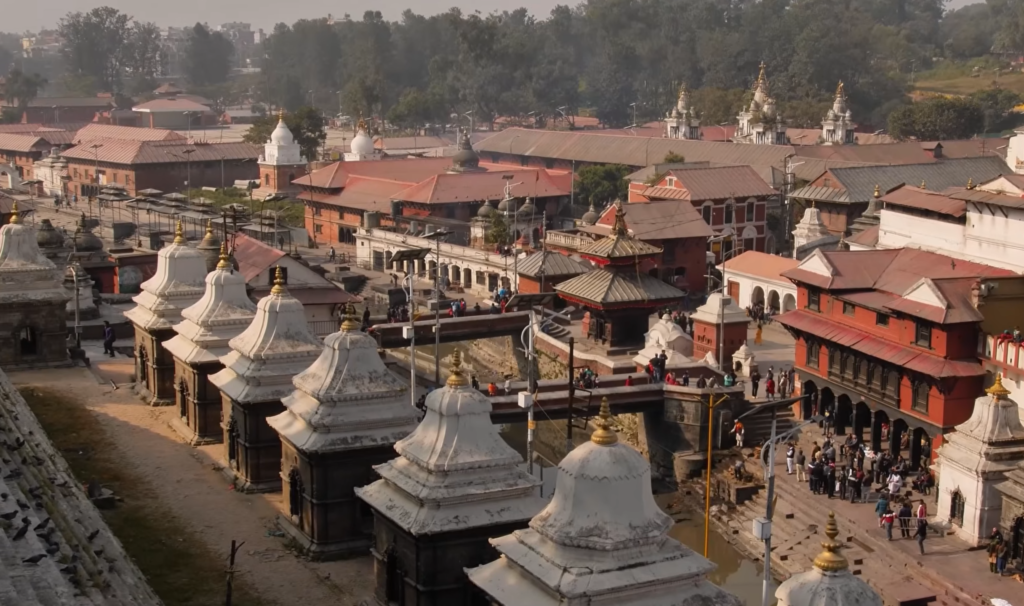
Security around this zone is notably strict by the standards of the wider complex: metal detectors, guarded entry points, and a standing presence of Nepalese police and, at times, military personnel reflect both the temple’s status as a site of major religious and national significance and the practical challenge of managing enormous daily pilgrim volumes. Photography is generally not permitted inside this courtyard, and — as covered in more detail in our Main Temple entry — access to the courtyard itself is restricted specifically to Hindus and, by longstanding practice, Buddhists, Sikhs, and Jains of Nepali or Indian background; non-Hindu visitors view the pagoda’s exterior from outside this zone, most commonly from the eastern riverbank or designated viewing terraces nearby.
| Feature | Location Relative to Main Temple |
|---|---|
| Nandi statue | Facing the sanctum, just inside the courtyard’s main entrance |
| Main pagoda | Center of the courtyard, on a single-tier stone plinth |
| Security checkpoints | At courtyard entry gates |
| Public viewing areas | Outside the courtyard, primarily the eastern riverbank |
Zone Two: The Ring of Secondary Shrines
Immediately surrounding the Main Temple’s fortified courtyard, though still within the temple’s broader inner precinct, sits a dense cluster of secondary shrines — smaller temples, each with its own dedicated deity, history, and, in several cases, its own centuries-long architectural record independent of the Main Temple’s own repeated reconstructions.
Moving outward from the Main Temple, sources consistently place several named shrines at roughly fixed positions relative to the central pagoda: the Chandeshvar shrine to the south, dated by some sources to as early as the 7th century and among the oldest datable structures in the immediate precinct; the Brahma Temple to the north; and the Vasuki Temple to the northeast, dedicated to the serpent king Vasuki and tended by its own designated priest distinct from the Main Temple’s Bhatta lineage. Other shrines recorded within this ring include a Surya Narayan Temple, an Unmatta Bhairav Temple, a Kirtimukh Bhairav shrine, and a Hanuman shrine — together representing a notably broad mix of Shaiva, Vaishnava, and folk-devotional traditions clustered within a single, densely built precinct.
Also within or near this inner ring are two distinctive linear arrangements that repeat a specific number of shrines in sequence: a row popularly referred to as containing twelve Jyotirlingas, echoing the twelve Jyotirlinga sites revered across the Indian subcontinent, and a separate row known locally as the Pandra Shivalaya, “fifteen Shivalayas” — a line of small, near-identical lingam shrines, most commonly found positioned along the riverside near the ghats rather than deeper within the courtyard ring. These rows function less as individually famous pilgrimage destinations in their own right and more as a devotional pattern: a repeated architectural gesture that multiplies the presence of the lingam symbol across the landscape surrounding the one central lingam inside the Main Temple.
| Shrine | Position Relative to Main Temple | Deity/Focus |
|---|---|---|
| Chandeshvar | South | Shiva-associated; among the oldest datable shrines in the precinct |
| Brahma Temple | North | Brahma |
| Vasuki Temple | Northeast | Vasuki, king of serpents |
| Surya Narayan Temple | Within inner precinct | Surya (sun) |
| Unmatta Bhairav Temple | Within inner precinct | Bhairav (fierce form of Shiva) |
| Kirtimukh Bhairav Shrine | Within inner precinct | Bhairav |
| Hanuman Shrine | Within inner precinct | Hanuman |
| Twelve Jyotirlinga row | Within/near inner precinct | Repeated lingam shrines |
| Pandra Shivalaya (fifteen shrines) | Along the riverside | Repeated lingam shrines |
Zone Three: The Ghats and the Bagmati Riverbank
Running along the Bagmati River immediately adjacent to the Main Temple courtyard is the complex’s chain of ghats — stone steps and platforms descending to the water, used for ritual bathing, purification, and, most visibly, cremation. This zone sits at a notably close physical distance from the Main Temple itself; the eastern edge of the temple courtyard essentially opens directly onto the riverside ghat system, meaning cremation rites at Pashupatinath take place, quite literally, in the shadow of the temple’s golden roofline.
Arya Ghat, positioned closest to the Main Temple, holds the highest ritual status among the complex’s cremation ghats and has traditionally been reserved for royalty and high-caste cremations, while other ghats further along the riverbank accommodate the general public. Beyond cremation, the ghats also serve routine ritual bathing throughout the day, and during major festivals such as Shivaratri and Teej, the riverbank becomes one of the most crowded and visually striking parts of the entire complex, with pilgrims bathing, praying, and gathering along the stone steps in large numbers. For a closer look at cremation practice specifically, see our Cremation Area entry; for the ghats themselves as an architectural and ritual feature, see Ghats.
Zone Four: Across the River — Guhyeshwari, Gorakhnath, and Mrigasthali
A visitor who stops at the Main Temple courtyard and the immediate ghats has, in an important sense, only seen half of Pashupatinath. Crossing the Bagmati to its eastern bank opens onto a second major cluster of sacred sites that form an integral part of the wider complex rather than a separate destination.
Most significant among these is the Guhyeshwari Temple, dedicated to a form of the goddess Shakti and understood in regional Shakta and Shaiva tradition as intimately linked to Pashupatinath — the two sites are frequently visited together as a paired pilgrimage, with some traditions treating a visit to one as incomplete without the other. Also on this bank is the Gorakhnath Temple, associated with the Nath Sampradaya and the broader tradition of Himalayan Shaiva asceticism, reflecting the same forest-ascetic character described in our Sacred Forest entry. Nearby, the Kirateshwar Mahadev shrine adds a further layer to this eastern cluster, its name echoing the Kirata figure connected elsewhere in this site’s Mahabharata mythology entry, though this entry does not assert a documented historical link between the two beyond the shared name.
Immediately behind and around these shrines lies the Mrigasthali forest, the protected sacred grove and deer sanctuary described in detail in our Sacred Forest and Deer Story entries — the mythological setting for Shiva and Parvati’s time in deer form, and today a maintained conservation area managed by PADT. This eastern zone, taken together, functions as the complex’s quieter, more contemplative counterpart to the crowded ritual intensity of the Main Temple courtyard and ghats — a landscape of forest, smaller shrines, and ascetic tradition rather than the daily crowds and structured puja schedule of the central sanctum.
| Site (Eastern Bank) | Character |
|---|---|
| Guhyeshwari Temple | Shakti/goddess shrine, traditionally paired with Pashupatinath as a joint pilgrimage |
| Gorakhnath Temple | Associated with the Nath Sampradaya and Himalayan ascetic tradition |
| Kirateshwar Mahadev | Smaller shrine; name echoes but is not documented as historically tied to the Mahabharata’s Kirata episode |
| Mrigasthali forest | Protected sacred grove and deer sanctuary, setting of the Deer Story legend |
Zone Five: Ashrams, Dharamshalas, and Pilgrim Infrastructure
Beyond its temples and shrines, the wider Pashupatinath complex also incorporates a considerable amount of infrastructure supporting pilgrims and resident ascetics directly. Ashrams scattered through the grounds provide residence for sadhus, some of whom have lived semi-permanently within the complex for years, while dharamshalas — pilgrim rest-houses — have historically offered lodging for visiting devotees, particularly elderly pilgrims who travel to Pashupatinath specifically to spend their final days near the temple. This pattern of pilgrim infrastructure woven directly into the sacred landscape, rather than kept administratively separate from it, is part of what distinguishes Pashupatinath’s layout from a more purely monumental temple complex: living religious practice, in the form of resident ascetics and long-term pilgrims, occupies the same physical zones as the shrines themselves.
How the Zones Connect
Read together, these five zones describe less a single building and more a set of concentric and adjacent spaces, each with a distinct character and a distinct level of public access:
- The Main Temple courtyard — the most restricted, most heavily secured, and most ritually intense zone, accessible only to Hindus and traditionally Buddhists of Indian/Nepali background.
- The ring of secondary shrines — open more broadly, densely packed with smaller temples representing a wide range of Hindu traditions, immediately surrounding the central courtyard.
- The ghats — open to the public, the site of both daily ritual bathing and cremation, running directly alongside the temple precinct.
- The eastern riverbank cluster — Guhyeshwari, Gorakhnath, Kirateshwar Mahadev, and the Mrigasthali forest, generally more open and quieter, reachable by crossing the Bagmati.
- Ashrams and pilgrim infrastructure — distributed throughout the wider grounds rather than confined to one zone, supporting the complex’s ongoing life as a place of residence and pilgrimage rather than only a monument.
This layered structure is also why guidance on visiting Pashupatinath differs so much depending on what a visitor hopes to see. A pilgrim focused on darshan at the central lingam will spend most of their visit in Zone One and Two; a visitor interested in cremation ritual and the Bagmati’s religious role will spend time at the ghats; and a traveler drawn to the mythology and quieter forest landscape covered elsewhere in this site’s Mythology guide will want to make the crossing to the eastern bank rather than stopping at the main courtyard alone. For practical guidance tailored to each of these interests, see our Darshan Guide and Travel Guide.
Frequently Asked Questions
Is the entire Pashupatinath complex off-limits to non-Hindu visitors?
No — only the innermost Main Temple courtyard is restricted. The surrounding shrine ring, the ghats, and the eastern riverbank cluster, including Guhyeshwari and the Mrigasthali forest, are generally open to visitors of any background, subject to standard entry procedures.
Why do area figures for Pashupatinath vary so much between sources?
Because different figures describe different things: the immediate fenced temple courtyard is a small fraction of a hectare, while the wider protected Pashupati Area, including forest and riverbank zones on both banks, is commonly cited at roughly 246 to 264 hectares.
How many temples are actually in the complex?
Estimates commonly cite around 500 structures, with one frequently repeated figure of 518 temples, shrines, ashrams, and monuments; exact counts vary by source and by how narrowly “structure” is defined.
Do I need to cross the river to see the whole complex?
To see the complex’s full range, yes — the Main Temple, secondary shrine ring, and ghats sit on the western bank, while Guhyeshwari, Gorakhnath, and the Mrigasthali forest are on the eastern bank, reached by crossing the Bagmati.
Is Guhyeshwari Temple technically part of Pashupatinath, or a separate site?
It functions as a closely linked, frequently co-visited pilgrimage site rather than being physically inside the Main Temple’s courtyard; this guide treats it as part of Pashupatinath’s wider sacred landscape, consistent with how it is traditionally paired with the temple.
Where are cremations performed relative to the Main Temple?
Immediately alongside it — the ghats, including Arya Ghat, sit directly along the riverbank adjacent to the Main Temple courtyard, making cremation ritual a visible, ongoing part of the complex’s daily life rather than a separate or hidden activity.
For more direct answers, see our full FAQ section.
Where to Go Next
- Main Temple — the central pagoda at the heart of this layout
- Ghats — the riverside steps used for bathing and cremation
- Cremation Area — a closer look at funeral ritual along the Bagmati
- Sacred Forest — the Mrigasthali sanctuary across the river
- Courtyards — a closer look at the complex’s courtyard structure specifically
- Darshan Guide — practical guidance for visiting each zone
This entry is part of our Temple Complex guide, mapping the Pashupatinath complex — its main pagoda, golden roof, four doors, ghats, cremation grounds, shrines, and the architectural details that define it.
The Pashupatinath is an independent devotional and cultural resource. It is not the official website of the Pashupati Area Development Trust (PADT) or the Government of Nepal. For official temple notices, consult PADT directly.