The origin of Pashupatinath Temple is told through two intertwined threads: mythological accounts describing Shiva’s lingam as self-manifested on the banks of the Bagmati River, and historical chronicles that date the earliest documented shrine at the site to around 400 CE, during Nepal’s Licchavi period. Nepal’s oldest surviving chronicle, the Gopal Raj Vamshavali, credits Licchavi-era rulers with the temple’s earliest known construction, while devotional texts such as the Shiva Purana and local Nepalese legend explain the site’s sanctity through the story of Shiva’s broken antler and its rediscovery by a herdsman centuries later. Together, myth and history form a single, continuous origin story that Hindus in Nepal and across South Asia still treat as authoritative.
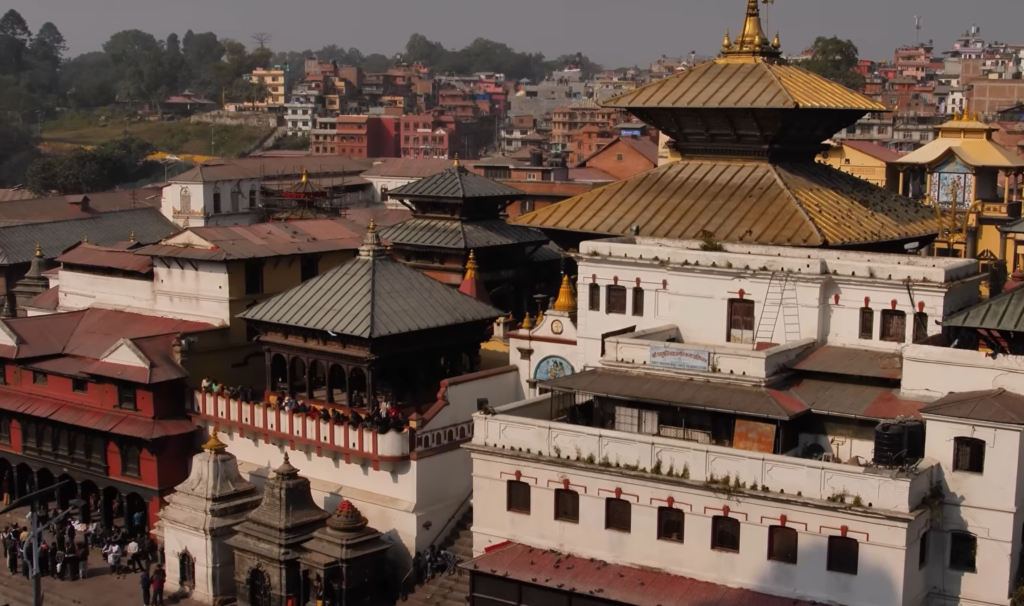
This page is part of our History guide and traces Pashupatinath’s origin from its scriptural roots through its earliest historical construction and its major medieval reconstructions, up to the temple structure that stands today. For the temple’s broader mythological universe, see Mythology; for a full year-by-year account of later developments, see Temple Timeline.
Quick Answer
| Earliest religious association with the site | Possibly pre-dating the Common Era, per some local tradition |
|---|---|
| Earliest documented structure | Circa 400 CE, Licchavi period |
| Primary source chronicle | Gopal Raj Vamshavali (compiled c. 1389 CE, covering the 5th–14th centuries) |
| Kings most often credited with early construction | Prachanda Deva and Supuspa Deva (accounts vary on which king built what) |
| Major medieval reconstruction | King Shivadeva (11th–12th century) and King Ananta Malla (roof addition) |
| Current structure largely dates to | Late 17th century, following termite and structural damage to earlier wooden buildings |
| Core mythological origin | Shiva’s broken antler, self-manifesting as a lingam in the earth |
| Secondary origin legend | A herdsman’s cow discovered pouring milk over the buried lingam |
Because different chronicles and modern sources present slightly different names, dates, and sequences, this page presents the most consistently cited version of events while noting where historical accounts diverge — a common feature of research into any temple whose early history predates reliable written record-keeping.
Two Kinds of “Origin”
Before tracing the timeline, it helps to separate two distinct but connected origin stories that Pashupatinath carries simultaneously:
- The mythological origin — why the site itself is considered inherently sacred, independent of any structure ever built on it. This explains why a temple exists here at all.
- The historical origin — when a physical shrine or temple was first constructed, expanded, and rebuilt, as recorded in chronicles, inscriptions, and later colonial and academic accounts. This explains what was actually built, and when.
Both threads matter equally to how Hindus understand Pashupatinath. The mythological account is not treated as a metaphor layered onto a historical site — it is treated as the reason the site was chosen for worship in the first place, with the historical construction understood as humanity formalizing a sanctity that was already present in the land itself.
The Mythological Origin: Shiva’s Broken Antler
The most widely told origin legend describes Shiva and his consort Parvati taking the form of deer (in some versions, antelope) and living freely in the forests along the eastern bank of the Bagmati River, in an area still known today as Mrigasthali (“deer place”), directly across from the main temple. According to the story, the other gods eventually located Shiva and, concerned that he had abandoned his cosmic responsibilities, moved to bring him back by force. In the struggle, one version holds that Vishnu seized Shiva by his horn, which broke and shattered.
The fragments of the broken horn are said to have sunk into the earth and, over time, transformed into a linga — the aniconic symbol through which Shiva is worshipped at Pashupatinath and at Shiva temples generally. This buried linga was, according to legend, eventually lost to memory and buried under earth and undergrowth for generations.
This legend directly explains several features still present at the temple complex today, including the sacred status of the Mrigasthali deer sanctuary and the temple’s own name — Pashupati, “Lord of All Animals” — tying Shiva’s identity at this specific site to his time spent among the deer of the forest. For the fuller narrative, including regional variations of the story, see our Mythology pillar and Temple Legends.
The Rediscovery Legend: The Cow, the Milk, and the Buried Linga
A second, closely linked legend explains how the buried linga was found again after being lost. In this account, a local herdsman noticed that one of his cows would walk daily to a specific spot in the forest and pour her milk directly onto the ground, rather than being milked normally. Curious and eventually troubled by the behavior, the herdsman investigated the site and began digging — uncovering a glowing, self-manifested (svayambhu) Shiva linga beneath the earth, later described in temple tradition as four-faced (chaturmukha).
Word of the discovery spread quickly, and the site was recognized as sacred, prompting the construction of a shrine to protect and formally worship the linga. Variants of this “cow and milk” discovery story appear at multiple other Shiva sites across South Asia, but at Pashupatinath it is treated as the direct link between the mythological antler legend and the beginning of formal, structured worship at the location — the moment where legend transitions into the start of recorded religious practice.
Scriptural Roots: The Shiva Purana and the Kedarnath Connection
Beyond local Nepalese legend, Pashupatinath’s origin is also tied to pan-Indian scripture. Certain passages associated with the Shiva Purana connect Pashupatinath to Kedarnath, one of India’s most sacred Himalayan Shiva shrines, through the story of the Pandavas — the central heroes of the Mahabharata — seeking Shiva’s forgiveness after the devastating Kurukshetra war. In this account, Shiva, reluctant to grant absolution so easily, took the form of a bull and burrowed into the ground to avoid the Pandavas. As they pursued him, his form separated: his hump is said to have remained at Kedarnath, while his head (or, in other retellings, a portion of his form) surfaced near the Bagmati River, becoming the sacred linga now enshrined at Pashupatinath.
This scriptural link is one reason Pashupatinath and Kedarnath are frequently mentioned together in pilgrimage literature, and why some devotional traditions treat visiting both sites as spiritually complementary rather than separate, unrelated pilgrimages.
Guhyeshwari and the Shakti Peeth Connection
Immediately across the Bagmati River from Pashupatinath stands Guhyeshwari Temple, and its origin story is treated as inseparable from Pashupatinath’s own. According to the Swasthani Brata Katha, a widely read Nepalese religious text, the goddess Sati died by self-immolation after her father insulted Shiva, and a devastated Shiva carried her body across the universe in grief. As Vishnu eventually intervened to cut the body into pieces to end Shiva’s destructive mourning, various parts of Sati’s body fell to earth at different locations, each becoming a Shakti Peeth — a site sacred to the divine feminine. One such part is said to have fallen at the site of present-day Guhyeshwari, directly linking the origin of that temple to Pashupatinath and reinforcing the entire riverside area as a single, unified zone of primal sanctity in Nepalese Hindu tradition, rather than two unrelated temples that happen to sit near one another.
See Guhyeshwari for more on this connected site.
The Pashupata Sect and Early Shaiva Ascetic Tradition
Pashupatinath’s historical rise as a major worship center is also linked to the spread of the Pashupata school of ascetic Shaivism, one of the oldest organized Shaiva traditions, traditionally traced back to the teacher Lakulisha. As Pashupata ascetic practice spread northward from India into the Himalayan region in the early centuries CE, Kathmandu Valley’s existing site of Shiva worship became closely associated with this movement, eventually functioning as one of its principal northern centers. This connection helps explain why Pashupatinath, specifically among Nepal’s many temples, became such an important destination for wandering ascetics and monastic Shaiva orders — a role the temple still visibly carries today through its resident sadhu community. See Saints for more on this ascetic tradition as it continues at the temple.
Historical Origins: The Licchavi Period (c. 400–750 CE)
Moving from myth and scripture into documented history, the earliest reliable references to a physical Pashupatinath temple come from Nepal’s Licchavi period. Nepal’s oldest surviving royal chronicle, the Gopal Raj Vamshavali — compiled around 1389 CE but recording genealogies and events reaching back to the 5th century — is the primary textual source historians rely on for this period. It attributes the founding of a temple dedicated to “Shri Pashupati Bhattaraka” to Licchavi rulers, though sources disagree on precise attribution:
- Some chronicle traditions credit King Prachanda Deva with constructing the earliest shrine at the site.
- Other readings of the Gopal Raj Vamshavali instead credit King Supuspa Deva, said to have ruled roughly between 464 and 505 CE, with building a five-story wooden temple over what had previously been a simple, open-air linga shrine (a devalaya).
Because the chronicle survives only in later copies and its genealogical sections are not always internally consistent, modern historical accounts — including academic summaries and encyclopedic sources — often present both figures rather than settling definitively on one. What is broadly agreed upon is the period itself: Licchavi-era Nepal, roughly the 5th century CE, as the earliest point at which a structured temple, rather than an open shrine, stood at the site.
Supporting this general period, a stone inscription within Pashupatinath’s own courtyard, dated to 753 CE and attributed to King Jayadeva II, references earlier Licchavi rulers by generational count, indirectly corroborating that organized worship — and likely a standing structure — had existed at the site for a considerable time before the inscription was carved.
Medieval Reconstruction: 11th to 13th Centuries
Wooden temple structures in the Kathmandu Valley’s humid climate were vulnerable to decay, insect damage, and periodic destruction, meaning Pashupatinath’s Licchavi-era structure did not survive unchanged. Chronicle sources describe a sequence of medieval reconstructions:
- King Shivadeva, generally placed in the 11th to 12th century (with some sources specifying a reign around 1099–1126 CE), is credited with substantially reconstructing the temple after earlier damage.
- King Ananta Malla, associated with the 13th century in most accounts, is credited with adding a formal roof structure to the temple, an upgrade that later sources treat as a significant step toward the tiered pagoda form the temple is known for today.
- Some traditions additionally credit the Licchavi ruler Bhaskar Verma, placed in the 6th century, with an early gilding of the temple’s roof — an account that, if accurate, would place the first gold ornamentation considerably earlier than the temple’s later, better-documented 17th-century reconstruction.
These centuries also saw expansion of the wider temple precinct rather than just the central shrine, with satellite temples — including a Vaishnava temple complex associated with a 14th-century Rama shrine — added around the main structure, beginning the transformation of Pashupatinath from a single building into the sprawling multi-temple complex visitors encounter today.
The Structure Standing Today: Late 16th to Late 17th Century
The version of Pashupatinath most visitors recognize — the two-tiered, gold-gilt pagoda with silver-plated doors — is considerably younger than the site’s founding. Sources vary somewhat on the exact sequence of this final major reconstruction phase, but the broad outline is consistent:
- By the late 16th century, under King Shivasimha Malla (reigned approximately 1578–1620 CE), the temple is described in some sources as having been restored into a form close to its modern layout.
- Wooden elements of the temple continued to suffer damage from termites and, in some accounts, earthquake activity, prompting further rebuilding in the late 17th century.
- The most commonly cited date for the temple’s final major reconstruction into its current form is 1692 CE, with some sources specifically crediting King Bhupatindra Malla, while others describe the work more generally as carried out by “local rulers” of the period, reflecting some inconsistency across secondary sources on exactly which Malla-era king oversaw the final rebuild.
Regardless of the precise attribution, historians agree on the outcome: by the close of the 17th century, Pashupatinath had taken on the architectural form — heavy stone plinth, two-tiered gilded copper roof, silver-sheeted doors, richly carved wooden struts — that has defined the temple ever since, with subsequent centuries bringing conservation, restoration, and expansion of the surrounding complex rather than further fundamental redesign of the main sanctum.
A Simplified Origin Timeline
| Period | Development |
|---|---|
| Pre-history / legendary era | Mythological origin: Shiva’s broken antler self-manifests as a linga near the Bagmati |
| Undetermined early period | Herdsman rediscovers the buried linga after his cow is seen pouring milk over the site |
| c. 400–505 CE (Licchavi period) | Earliest documented shrine/temple construction, credited variously to Prachanda Deva and/or Supuspa Deva |
| 753 CE | Courtyard stone inscription of King Jayadeva II references earlier Licchavi rulers, corroborating long-standing worship at the site |
| 11th–12th century | King Shivadeva reconstructs the temple after earlier decay/damage |
| 13th century | King Ananta Malla adds a formal roof structure |
| Late 16th century | King Shivasimha Malla restores the temple, per some sources, toward its modern form |
| 1692 CE | Final major reconstruction produces the two-tiered gold pagoda structure seen today |
| 1979 CE | Pashupatinath inscribed as part of the Kathmandu Valley UNESCO World Heritage Site |
For everything that happened after this point — including 20th-century conservation, the 2015 earthquake, and present-day management — see our full Temple Timeline.
Why Pashupatinath’s Origin Story Still Matters
Understanding Pashupatinath’s origin is not simply an academic exercise — it directly shapes how the temple is understood and experienced today:
- The mythological origin explains ritual features still practiced at the temple, including the sacred status of deer at Mrigasthali and the symbolic meaning of the multi-faced lingam inside the sanctum.
- The historical origin, with its documented sequence of reconstruction across multiple dynasties, is central to why UNESCO and heritage scholars treat Pashupatinath as a site of exceptional historical continuity, not merely religious importance. See UNESCO World Heritage for how this history factored into the site’s formal recognition.
- The layered, sometimes inconsistent chronicle record is itself part of why Pashupatinath is treated as an object of serious historical study, referenced across numerous academic works. See Research Papers, Books, and Sanskrit References for primary and scholarly sources.
- The origin legends themselves remain part of a living storytelling tradition at the temple, recounted by priests, guides, and pilgrims much as they were centuries ago. See Kings and Miracles for more stories connected to the site’s founding and subsequent history.
Frequently Asked Questions
How old is Pashupatinath Temple?
Devotional tradition holds the site’s sanctity predates any structure, but the earliest documented physical temple dates to around 400 CE, during Nepal’s Licchavi period, making the site well over 1,500 years old by conservative historical estimates.
Who built the original Pashupatinath Temple?
Nepal’s oldest chronicle, the Gopal Raj Vamshavali, credits Licchavi-era rulers, with different passages naming either King Prachanda Deva or King Supuspa Deva as responsible for the earliest known temple structure.
What is the mythological origin of Pashupatinath?
The most widely told legend describes Shiva taking the form of a deer and later losing part of his antler in a struggle with the other gods; the broken antler is said to have transformed into a self-manifested linga in the earth, later rediscovered by a herdsman whose cow was seen pouring milk over the buried site.
When was the current temple structure built?
The two-tiered gold pagoda structure recognized today dates largely from a major reconstruction commonly placed at 1692 CE, following termite and structural damage to earlier wooden buildings, though some sources attribute portions of this restoration to slightly earlier Malla-era rulers.
Is Pashupatinath connected to Kedarnath’s origin?
Yes, according to passages associated with the Shiva Purana, both temples are linked through the story of Shiva taking the form of a bull to evade the Pandavas after the Kurukshetra war, with his hump remaining at Kedarnath and another part of his form emerging near the Bagmati River at Pashupatinath.
Why do sources disagree on some names and dates in Pashupatinath’s origin?
Much of the site’s early history survives only through chronicles compiled centuries after the events they describe, such as the Gopal Raj Vamshavali, alongside oral legend and later inscriptions. This is common for ancient South Asian temples and is why historical accounts of Pashupatinath’s founding present multiple, sometimes overlapping, versions rather than a single uncontested record.
For more direct answers on the temple generally, see our full FAQ section.
Where to Go Next
- History — the complete recorded history across the Kirat, Licchavi, Malla, Shah, and Rana eras
- Temple Timeline — a full year-by-year account of the temple’s development
- Mythology — the complete scriptural and legendary foundations of the site
- Temple Legends, Saints, Kings, and Miracles — the wider body of stories connected to the temple
- Guhyeshwari — the closely linked Shakti Peeth across the Bagmati River
- What is Pashupatinath? and Why is Pashupatinath Famous? — foundational context on the temple today
- UNESCO World Heritage — how this history informed the site’s 1979 designation
This entry is part of our History guide, covering the recorded and legendary origins of Pashupatinath Temple from its earliest associations through its final major reconstruction.
The Pashupatinath is an independent devotional and cultural resource. It is not the official website of the Pashupati Area Development Trust (PADT) or the Government of Nepal. For official temple notices, consult PADT directly.