Pashupatinath’s timeline stretches from a mythological origin with no fixed date, through the earliest documented temple construction around 400 CE under Licchavi rulers, a devastating 14th-century looting and rebuilding, successive Malla-era reconstructions culminating in the temple seen today, centuries of royal Shah-dynasty patronage, and its 1979 recognition as a UNESCO World Heritage Site. Few temples anywhere have a documented history spanning this many distinct political eras — Kirat, Licchavi, Malla, Shah, and Rana — while remaining in continuous religious use throughout. This page lays out that history as a clear, chronological timeline, from legend to the present day.
This entry is part of our About Pashupatinath guide. For the deeper narrative behind the earliest entries on this timeline, see Origin in our History guide; for how this history led to international recognition, see UNESCO World Heritage.
Quick Answer: The Timeline at a Glance
| Period | Event |
|---|---|
| Mythological era | Shiva’s broken antler self-manifests as a linga near the Bagmati River |
| Undated legendary period | A herdsman’s cow reveals the buried linga, prompting the first shrine |
| c. 400–505 CE | Earliest documented Licchavi-era temple construction, credited to Prachanda Deva and/or Supuspa Deva |
| 753 CE | Courtyard stone inscription of King Jayadeva II references earlier Licchavi rulers |
| 11th–12th century | King Shivadeva reconstructs the temple |
| 13th century | King Ananta Malla adds a formal roof |
| 1349 CE | Temple looted and the lingam damaged during a raid attributed to Sultan Shamsuddin of Bengal |
| Late 14th century | Temple rebuilt and the lingam restored under King Jayarjuna Deva |
| 16th–17th century | Malla-era reconstructions, including work attributed to Shivasimha Malla |
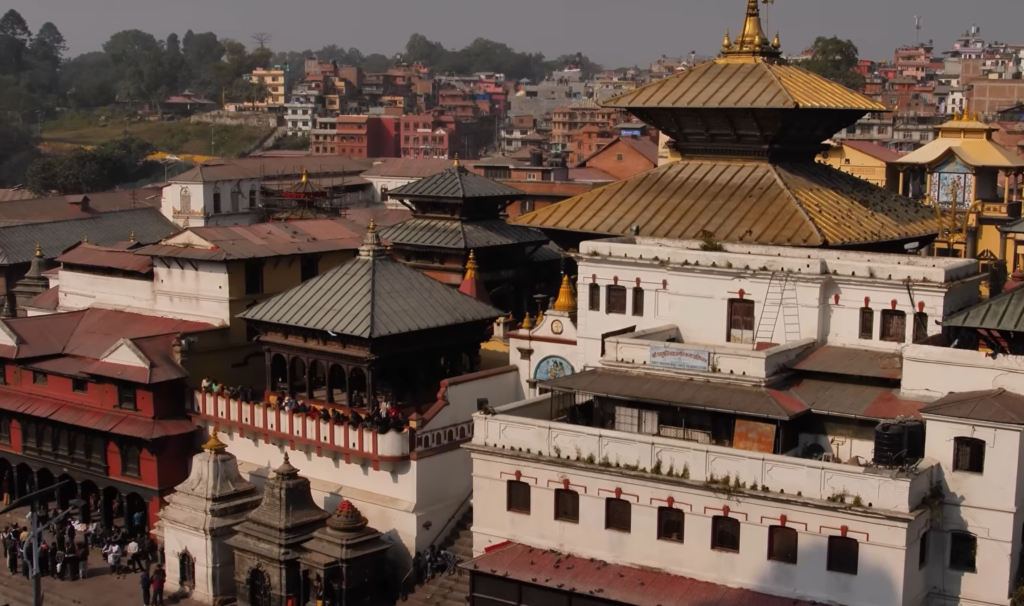
| 1692–1697 CE | Final major reconstruction produces the two-tiered gold pagoda seen today |
| 1768–1769 CE | Prithvi Narayan Shah unifies Nepal and establishes Kathmandu as the capital; Pashupatinath becomes the state’s royal temple |
| Late 18th–early 19th century | Shah-era kings formalize temple trusts and land endowments |
| 1846–1951 | Rana era; temple maintained under hereditary prime ministerial rule |
| 1956 | Nepal’s Ancient Monuments Preservation Act formally protects the site |
| 1979 | Pashupatinath inscribed as part of the Kathmandu Valley UNESCO World Heritage Site |
| 1986 | Pashupati Area Development Trust (PADT) established |
| 2003–2007 | Kathmandu Valley listed, then removed, from UNESCO’s “World Heritage in Danger” list |
| 2008 | Nepal’s monarchy formally abolished; Pashupatinath’s national symbolism persists independently of royal rule |
| 2015 | Gorkha earthquake damages the wider Kathmandu Valley; Pashupatinath’s main structures are comparatively spared |
| Present day | Continuous daily worship, ongoing conservation, and annual Maha Shivaratri gatherings of over a million pilgrims |
The sections below expand on each of these periods.
The Mythological Starting Point
Before any historical date can be assigned, Pashupatinath’s timeline begins in legend. According to the most widely told account, Shiva and Parvati took the form of deer and lived in forests along the Bagmati River, in an area still known today as Mrigasthali. When the other gods located Shiva and attempted to bring him back to his cosmic duties, his horn broke in the struggle and its fragments sank into the earth, later self-manifesting as a sacred linga.
A second legend explains the linga’s rediscovery: a herdsman noticed his cow pouring milk daily over a specific spot of ground, and digging at the site revealed a glowing, self-manifested four-faced (chaturmukha) linga, prompting the construction of the first shrine. These stories are treated in Hindu tradition not as separate from the historical record but as its necessary starting point — establishing why a temple was ever built at this specific location. The full narrative, along with scriptural variants connecting Pashupatinath to Kedarnath and to the Shakti Peeth tradition at nearby Guhyeshwari, is covered in our Origin and Mythology pages.
The Kirat and Early Settlement Period
Nepal’s oldest chronicles describe a succession of early ruling dynasties over the Kathmandu Valley — traditionally listed as the Gopal, Kirat, Licchavi, Malla, and Shah lines — with religious activity at the Pashupatinath site referenced across this lineage. While concrete archaeological or inscriptional evidence from the Kirat period specifically is limited, later chronicle traditions treat reverence for the site as predating the Licchavi era, consistent with the idea that Pashupatinath’s sanctity as a place of worship considerably predates any surviving built structure.
The Licchavi Period: c. 400–753 CE
The Licchavi period provides the earliest reliably documented references to a physical temple at Pashupatinath. Nepal’s oldest surviving chronicle, the Gopal Raj Vamshavali (compiled around 1389 CE but recording earlier genealogies), attributes the earliest known temple construction to Licchavi rulers, though different chronicle passages name different kings:
- King Prachanda Deva is credited in some readings with founding the earliest shrine.
- King Supuspa Deva, placed by some sources within the 5th century CE (roughly 464–505 CE), is credited elsewhere with constructing a five-story wooden temple over what had previously been a simple, open-air linga shrine.
Because the chronicle survives only through later copies, modern historical summaries typically present both figures rather than resolving the question definitively — a pattern of source disagreement discussed more fully on our Origin page.
Supporting this general period, a stone inscription within the temple courtyard, dated to 753 CE and attributed to King Jayadeva II, references earlier Licchavi rulers by generational count. This inscription is one of the most important pieces of physical evidence historians point to when dating organized worship at the site, since it confirms Pashupatinath’s established religious importance well before the year 800 CE.
Medieval Reconstruction: 11th to 13th Centuries
Wooden temple structures in the Kathmandu Valley’s humid climate required periodic rebuilding, and chronicle sources describe a sequence of medieval renovations following the Licchavi period:
- King Shivadeva, generally placed in the 11th to 12th century (some sources specify a reign around 1099–1126 CE), reconstructed the temple after earlier decay.
- King Ananta Malla, associated with the 13th century, is credited with adding a formal roof structure — a significant step toward the tiered pagoda form recognizable today.
This period also saw the temple precinct begin its expansion beyond a single structure, with satellite shrines added around the main sanctum, setting the pattern that would eventually produce the sprawling, multi-temple complex described on our Temple Complex page.
The 1349 Looting and Its Aftermath
One of the most significant — and often overlooked — events in Pashupatinath’s timeline is a 14th-century raid that severely damaged the temple. According to historical accounts, in 1349 CE, forces associated with Sultan Shamsuddin of Bengal raided the Kathmandu Valley, and Pashupatinath was looted during the incursion, with the sacred Shiva lingam reportedly broken in the process — a rare recorded instance of deliberate damage to the temple’s most sacred object.
The temple was subsequently rebuilt and the lingam restored under the reign of King Jayarjuna Deva, a ruler associated with the valley’s late medieval period. This episode is significant not only as a moment of destruction but as an early example of the pattern that defines much of Pashupatinath’s later history: periodic damage, whether from decay, disaster, or conflict, consistently followed by deliberate, ritually significant reconstruction rather than abandonment.
The Malla Dynasty and the Temple’s Final Reconstruction
The Malla dynasty, which dominated the Kathmandu Valley from roughly the 12th through the 18th centuries, was responsible for the majority of the architectural refinement that produced Pashupatinath’s modern form. Malla-era kings were major patrons of temple construction generally across the valley, and Pashupatinath received sustained attention across this long dynastic period:
- By the late 16th century, under King Shivasimha Malla (reigned approximately 1578–1620 CE), some sources describe the temple as having been restored close to its modern layout.
- Continued termite damage and structural decay to wooden elements prompted further reconstruction into the late 17th century.
- The temple’s final major reconstruction is most commonly dated to 1692–1697 CE, with some sources crediting King Bhupatindra Malla and others crediting a closely named ruler recorded as Bhupalendra Malla — a discrepancy that reflects the same kind of chronicle inconsistency found throughout Pashupatinath’s early history, rather than two separate, confirmed reconstructions.
This final rebuilding produced the temple’s signature two-tiered, gold-gilt copper roof, silver-plated doors, and richly carved wooden struts. Notably, one historical account describes the temple as originally having five roofs in earlier pagoda form before later settling into the two-roof design familiar today — evidence that even the “final” 17th-century reconstruction was refined further in the years that followed. This is the structure that remains standing, essentially unchanged in its core form, into the present day.
Shah Dynasty Patronage: 1559–1846
The Shah dynasty, founded in the Gorkha kingdom in 1559, rose to national prominence when King Prithvi Narayan Shah completed his campaign to unify Nepal’s fragmented Malla-era kingdoms, declaring Kathmandu the capital of a unified Nepal in 1768–1769. From this point forward, Pashupatinath’s status shifted from a major regional temple to Nepal’s de facto royal and national shrine, a role it retained for over two centuries.
Key developments during Shah rule include:
- Formal establishment of religious trusts and land endowments dedicated to the temple’s upkeep, with surviving records from the reign of King Rana Bahadur Shah (1775–1806) documenting structured management of Pashupatinath’s worship and maintenance.
- At the start of the 19th century, King Girvan Yuddha Bikram Shah (reigned 1797–1816) further expanded royal patronage of the temple, including dedications of nearby land and fortifications connected to its protection.
- Continued royal association with Aryaghat, the cremation ghat closest to the main temple, which became customarily reserved for royal and dignitary cremations — a tradition that persisted throughout the monarchy’s history.
This period cemented Pashupatinath’s dual identity, discussed further on our Why is Pashupatinath Famous? page: a site of Hindu pilgrimage on one hand, and a symbol of Nepali statehood on the other. For the rulers connected to this era, see Kings.
The Rana Era: 1846–1951
Beginning in 1846, Nepal entered a distinct political period during which hereditary prime ministers from the Rana family held effective governing power, while the Shah kings remained largely ceremonial figureheads. Pashupatinath continued to be maintained and patronized as the national shrine throughout this century-long period, with its management structured around the same trust-based system established under earlier Shah rulers. The Rana era ended in 1951 with the restoration of full monarchical power, setting the stage for Nepal’s mid-20th-century modernization, including its first formal heritage protection legislation.
The Modern Legal and Conservation Era: 1956–1986
The mid-to-late 20th century brought Pashupatinath under formal, modern legal protection for the first time:
- 1956 (2013 B.S.): Nepal enacted the Ancient Monuments Preservation Act, establishing the country’s first comprehensive legal framework for protecting historic monuments, under which Pashupatinath was registered as a protected site.
- 1979: Pashupatinath was inscribed as one of seven monument zones making up the Kathmandu Valley UNESCO World Heritage Site, formally recognized under cultural criteria (iii), (iv), and (vi). Full details of this designation, including its selection criteria and later conservation history, are covered on our UNESCO World Heritage page.
- 1986: The Pashupati Area Development Trust (PADT) was formally established to manage the temple precinct’s conservation, development, and daily administration, with then-King Birendra Bir Bikram Shah serving as its first chief patron — continuing the monarchy’s centuries-long custodial relationship with the site even as management became increasingly formalized under modern institutional structures.
Recent History: 2003 to Present
The 21st century has brought both institutional challenge and physical risk to Pashupatinath and the wider Kathmandu Valley heritage zone:
- 2003: The Kathmandu Valley World Heritage Property, including the Pashupatinath monument zone, was placed on UNESCO’s List of World Heritage in Danger, citing loss of authenticity and integrity linked to unregulated urban development.
- 2007: Following documented conservation improvements, the property was removed from the Danger List.
- 2008: Nepal formally abolished its monarchy, ending the centuries-long Shah dynastic rule that had shaped much of Pashupatinath’s modern history. Despite this political transition, the temple retained its cultural status as a national shrine, its religious and symbolic importance operating independently of the monarchy that had once been its chief patron.
- 2015: The Gorkha earthquake struck central Nepal, severely damaging several Kathmandu Valley monument zones. Pashupatinath’s main temple and cremation ghats were comparatively spared serious structural damage, though nearby structures such as Jaya Bageshwari Temple were affected, and broader reconstruction debates over traditional versus modern building materials continued across the valley for years afterward.
- Present day: Pashupatinath continues to function as it always has — a site of daily worship, ritual, and cremation, drawing well over a million pilgrims during its largest annual event, Maha Shivaratri, while remaining under active conservation management by PADT in coordination with Nepal’s Department of Archaeology and UNESCO’s ongoing monitoring.
Why This Timeline Matters
Pashupatinath’s history is unusual not because any single event on this timeline is exceptional in isolation, but because of what the full sequence together demonstrates: a site that has been built, damaged, rebuilt, formally protected, internationally recognized, politically reattached to a changing Nepali state, physically threatened by disaster, and continuously worshipped — without interruption — across more than 1,500 years. Few religious sites anywhere carry this combination of mythological depth, documented political history, and unbroken ritual continuity.
This is also why historical accounts of specific dates and rulers sometimes vary between sources: much of Pashupatinath’s early record survives only through chronicles compiled centuries after the events they describe, alongside inscriptions, colonial-era records, and oral tradition. Where this page notes disagreement between sources — such as which king oversaw the final 17th-century reconstruction — that reflects the genuine state of the historical record rather than a simplification for readability.
Frequently Asked Questions
What is the oldest confirmed date in Pashupatinath’s history?
The earliest reliably documented physical temple construction dates to approximately 400–505 CE, during Nepal’s Licchavi period, though the site’s religious significance is traditionally considered to predate this by a considerable margin.
Was Pashupatinath ever destroyed?
The temple was looted and its sacred lingam damaged during a raid in 1349 CE attributed to Sultan Shamsuddin of Bengal. It was subsequently rebuilt and the lingam restored under King Jayarjuna Deva.
When was the current temple structure built?
The two-tiered gold pagoda structure seen today dates largely from a major reconstruction commonly placed between 1692 and 1697 CE, following termite and structural damage to earlier wooden buildings.
How is Pashupatinath connected to Nepal’s monarchy?
From the unification of Nepal under Prithvi Narayan Shah in 1768–1769 until the monarchy’s abolition in 2008, Pashupatinath functioned as Nepal’s de facto royal and national shrine, with kings serving as its chief patrons and Aryaghat traditionally reserved for royal cremations.
When did Pashupatinath become a UNESCO World Heritage Site?
In 1979, as one of seven monument zones inscribed collectively as the Kathmandu Valley World Heritage Property.
Was Pashupatinath damaged in the 2015 earthquake?
The main temple and ghats sustained comparatively minor damage relative to other Kathmandu Valley monument zones, though the wider monument zone and nearby structures were affected.
Who manages Pashupatinath today?
The Pashupati Area Development Trust (PADT), established in 1986, manages the site’s daily administration and conservation, working alongside Nepal’s Department of Archaeology and UNESCO’s ongoing monitoring of the Kathmandu Valley World Heritage Property.
For more direct answers, see our full FAQ section.
Where to Go Next
- Origin — a deeper look at the temple’s mythological and earliest historical roots
- History — the complete narrative account across every era
- UNESCO World Heritage — full details on the 1979 designation and its aftermath
- Kings and Saints — figures connected to specific points on this timeline
- Temple Legends and Miracles — stories connected to the temple’s history
- Temple Complex — how this history shaped the site’s present-day layout
- What is Pashupatinath? and Why is Pashupatinath Famous? — foundational context on the temple today
- Research Papers, Books, and Sanskrit References — primary and scholarly sources behind this timeline
This entry is part of our About Pashupatinath guide, covering the essential facts, history, mythology, and rituals of Pashupatinath Temple.
The Pashupatinath is an independent devotional and cultural resource. It is not the official website of the Pashupati Area Development Trust (PADT) or the Government of Nepal. For official temple notices, consult PADT directly.