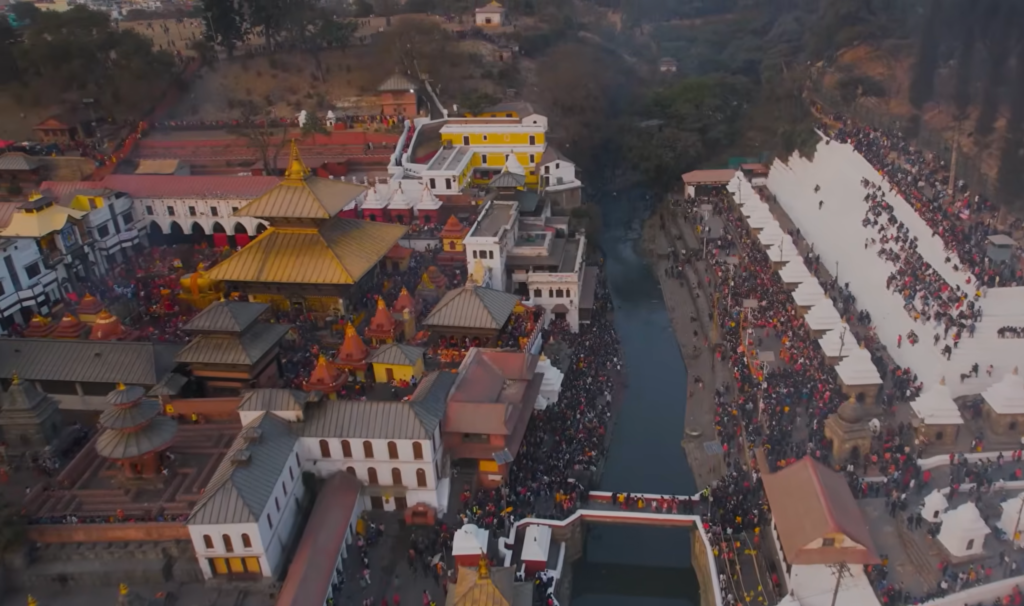
The Pashupatinath complex is not one temple but a precinct of more than 500 temples, shrines, and sacred structures spread across roughly 246 hectares along the Bagmati River — including named shrines dedicated to Vasuki Nath, Bhairav, Guhyeshwari, Gorakhnath, Rama, Brahma, and dozens of others, alongside collective shrine groups such as the 12 Jyotirlinga replicas and the Pandra Shivalaya. This directory catalogs the most significant individually named temples and shrines within the complex, organized by where they sit within the precinct, so visitors, researchers, and devotees can understand what they’re looking at — and why it’s there.
This entry is part of our About Pashupatinath guide. For the layout and architecture of the complex as a whole, see Temple Complex; for the numbers behind the site’s scale, see Quick Facts and Temple Facts.
Quick Answer
| Total structures in the complex | Reported at 500 to 520+ across different sources |
|---|---|
| Total area | Approximately 246–264 hectares (sources vary) |
| Main zones covered in this directory | Inner courtyard, outer courtyard and wider precinct, across-river zone (Guhyeshwari and Gorakhnath), and the riverside ghats |
| Notable individually named shrines | 30+ documented by name in guidebooks, academic sources, and temple literature |
| Notable shrine groups | 12 Jyotirlinga replica temple, Pandra Shivalaya (15 shrines), and a large cluster of Shivalinga shrines (variously cited as 108 or 184) |
| Oldest dated individual structure cited | A 7th-century Licchavi linga inscription (Chandeshwar) |
Because Pashupatinath has been continuously expanded for well over a millennium, no single published source lists every shrine within the complex with full consistency — figures and names vary slightly across UNESCO documentation, academic surveys, and temple literature. This directory reflects the most consistently cited and verifiable structures.
How This Directory Is Organized
Pashupatinath’s shrines are traditionally understood in relation to four broad zones:
- The inner courtyard — the fortified area immediately surrounding the main pagoda, restricted primarily to Hindu devotees and containing the temple’s oldest and most ritually central subsidiary shrines.
- The outer courtyard and wider precinct — the broader complex on the western side of the Bagmati, open to all visitors, containing the majority of named individual temples.
- Across the Bagmati — the eastern bank, home to Guhyeshwari Temple, Gorakhnath Temple, and the Mrigasthali deer sanctuary.
- The ghats — the riverside cremation and bathing platforms, which, while not temples in the traditional sense, form an integral and named part of the sacred precinct.
Each section below lists the significant named structures within that zone.
Zone 1: The Inner Courtyard
These shrines sit closest to the main sanctum and are typically encountered by devotees on their way to darshan of the central lingam.
- Vasuki Nath Temple — A small pagoda-style shrine in the northeast corner of the courtyard, dedicated to Vasuki, King of the Nagas (serpent deities). Local tradition holds that Vasuki resides here specifically to protect Pashupatinath, and many devotees circumambulate and worship this shrine before entering the main sanctum.
- Unmatta Bhairav Temple — Dedicated to Unmatta Bhairav, one of the eight wrathful forms of Bhairav (Shiva’s fierce aspect), represented by a large metallic image south of the main temple.
- Kirtimukha Bhairav Shrine — Located on the temple’s western façade, dedicated to one of the most fearsome forms of Bhairav, said in local legend to have been created by Shiva specifically to frighten off the demon Rahu.
- Surya Narayan Temple — A shrine dedicated to Surya, the sun deity, within the inner courtyard.
- Budhanilkantha Shrine — A smaller courtyard shrine referencing the Budhanilkantha form of Vishnu, distinct from Kathmandu’s separate, larger Budhanilkantha Temple elsewhere in the valley.
- Hanuman Shrine — Dedicated to Hanuman, the devoted monkey deity of the Ramayana.
- Ganesh Temple — Positioned directly in front of the main temple’s eastern façade, dedicated to Ganesh, son of Shiva and Parvati; a resident priest offers blessings to visiting devotees here.
- Shivalinga Shrine Cluster — A dense grouping of individual small Shivalinga shrines within the courtyard, variously reported across sources as containing 108 or 184 separate lingas — one of the largest concentrations of Shiva lingas at any single site in the world.
- Nandi (bronze bull statue) — A large bronze image of Nandi, Shiva’s bull and vehicle, positioned facing the main temple’s western entrance.
Zone 2: The Outer Courtyard and Wider Precinct
Beyond the immediate temple courtyard, the wider Pashupatinath precinct contains a substantial number of independently significant temples, many centuries old in their own right.
- Ram Mandir (Ram Temple) — A temple dedicated to Lord Rama, believed to date from the 14th century, part of a Vaishnava temple cluster within the predominantly Shaiva complex. See our dedicated Ram Mandir page.
- Virat Swaroop Temple — Dedicated to Vishnu in his cosmic, universal form (Virat Swaroopa), reflecting the presence of Vaishnava worship alongside the complex’s dominant Shaiva tradition.
- Brahma Temple — A temple associated with Brahma, dated by some sources to the 9th century, located north of the main temple.
- Chandeshwar — Not a standalone temple but an inscribed Licchavi-era linga dated to the 7th century, located south of the main temple and considered one of the oldest surviving inscribed objects at the site.
- Bhuvaneshwari Temple — A shrine dedicated to Bhuvaneshwari, a form of the Divine Mother within Shakta tradition.
- Dakshinamurti Shrine — Associated with Dakshinamurti, an aspect of Shiva depicted as a supreme teacher and source of knowledge.
- Tamreshwar Mahadev — A Shiva shrine within the wider precinct, one of several “Mahadev” (Great God) forms of Shiva represented across the complex.
- Panchadeval Complex — Historically a religious rest-house structure established in 1882 CE under King Surendra Bir Bikram Shah; today it functions as a social welfare center and elderly care home rather than an active devotional shrine, though it remains part of the historic precinct.
- Jaya Bageshwari Temple — A temple located near the Pashupatinath complex, notable for having sustained damage during the 2015 Gorkha earthquake even as the main temple itself was largely spared.
- Birupakshya Temple (Kirateshwor Mahadev) — Located on the northern bank of the Bagmati, associated with the Kirat people, one of Nepal’s earliest ruling dynasties, and considered a shrine to an ancestral Kirat deity; also known as Kirateshwar Mahadev, linking it to Mahabharata-era legend.
- Raj Rajeshwari Temple — A temple along the western bank of the Bagmati near the cremation zone, notable for its unusual curved stucco outbuildings.
- Standing Buddha Image — A 7th-century standing Buddha statue located near Raj Rajeshwari Temple, reflecting Pashupatinath’s historical significance to Buddhist as well as Hindu tradition — the wider Pashupati area is also recognized in Vajrayana Buddhist tradition as a sacred charnel ground associated with tantric masters including Padmasambhava.
- Baman Tribikram Sculpture — Also known locally as Dhapadev, this sculpture is attributed to the Licchavi king Man Dev and is considered among the oldest surviving sculptures in Nepal.
Additional named shrines documented across temple literature and regional guides include Gauri, Grihayakali, Sitaram, Lakshmi Narayan, Neel Saraswati, Mangalgauri, Bhasmeshwar, Mata Vatsala, and Mrigeshwar — reflecting the complex’s role as a home to Shaiva, Vaishnava, and Shakta worship traditions side by side.
Zone 3: Across the Bagmati — Guhyeshwari, Gorakhnath, and the Eastern Bank
The eastern side of the Bagmati River, connected to the main temple by footbridges and pathways, holds some of the complex’s most historically and mythologically significant sites.
- Guhyeshwari Temple — One of the most important Shakti Peeth sites in the Kathmandu Valley, dedicated to the goddess Guhyeshwari, an aspect of Parvati/Sati. According to the Swasthani Brata Katha, part of the goddess Sati’s body fell at this location following her self-immolation, making the temple’s origin story directly linked to Pashupatinath’s own. See our dedicated Guhyeshwari page.
- Gorakhnath Temple — Situated atop a hill reached by stairs from the eastern ghats, dedicated to the yogi Gorakhnath, founder of the Nath monastic tradition and closely associated with the development of Hatha Yoga. Legend holds that Gorakhnath spent time meditating and teaching in this area after a period of penance in the Himalayas. The temple’s interior is generally closed to the public, though sadhus frequently worship from outside.
- Vatsaleshwari Temple — A two-tiered pagoda-style temple on the riverbank between Aryaghat and the Bhasmeshwar Shivalaya, dedicated to Vatsaleshwari, considered an embodiment of Goddess Parvati. Rather than housing a conventional idol, the temple centers on a peeth (sacred seat), beneath which sits a shrine to Patal Bhairav. The associated Vatsaleshwari Jatra is one of the significant annual festivals celebrated within the Pashupati area.
- Mrigasthali — The deer sanctuary directly tied to Pashupatinath’s origin legend, where Shiva and Parvati are said to have taken the form of deer; several smaller shrines are located within and around this forested area.
- Yogi’s Caves — A series of meditation caves at the northern end of the ghats, visible from across the river, used by ascetics since medieval times and still in occasional use by meditators today.
- Sati’s Gate — A named site along the eastern precinct associated with the broader Sati/Guhyeshwari mythological tradition connecting the two banks of the river.
Zone 4: The Ghats
While not temples in the conventional sense, Pashupatinath’s riverside ghats are named, sacred structures central to the complex’s religious function, particularly its role in Hindu funerary ritual.
- Aryaghat — The most prominent cremation ghat, positioned closest to the main temple and historically reserved for the cremation of Nepali royalty and dignitaries.
- Ram Ghat and Surya Ghat — Additional cremation ghats within the complex, historically used according to caste distinctions, reflecting the traditional structure of Hindu funerary practice in Nepal.
- Gaurighat — A ghat associated with ritual bathing, located within the wider Pashupati precinct.
For more on the religious role these sites play, see Spiritual Importance and What is Pashupatinath?.
Grouped and Numbered Shrine Collections
Beyond individually named temples, Pashupatinath contains several notable collections of shrines, grouped and counted as a set rather than named individually:
- The 12 Jyotirlinga Temple — A dedicated structure within the outer complex replicating India’s twelve Jyotirlingas (self-manifested forms of Shiva’s light), allowing devotees to symbolically honor all twelve sites in a single visit.
- Pandra Shivalaya (“Fifteen Shivalaya”) — A grouped set of fifteen Shiva shrines within the wider precinct.
- The Shivalinga Shrine Cluster — As noted above, a dense concentration of small individual lingas within the inner courtyard, cited by different sources as either 108 or 184 in number — a discrepancy likely reflecting different counting conventions or changes to the cluster over time.
These numbered groupings are part of why total shrine counts for the complex vary between sources: whether a “184-linga shrine” is counted as one structure or 184 individual ones significantly changes the final total reported.
Full Directory at a Glance
| Temple / Shrine | Zone | Associated Deity or Figure |
|---|---|---|
| Main Pashupatinath Temple | Inner sanctum | Shiva (as Pashupati) |
| Vasuki Nath Temple | Inner courtyard | Vasuki, King of the Nagas |
| Unmatta Bhairav Temple | Inner courtyard | Bhairav |
| Kirtimukha Bhairav Shrine | Inner courtyard | Bhairav |
| Surya Narayan Temple | Inner courtyard | Surya |
| Budhanilkantha Shrine | Inner courtyard | Vishnu |
| Hanuman Shrine | Inner courtyard | Hanuman |
| Ganesh Temple | Inner courtyard | Ganesh |
| Shivalinga Shrine Cluster | Inner courtyard | Shiva (multiple lingas) |
| Nandi Statue | Inner courtyard | Nandi (Shiva’s bull) |
| Ram Mandir | Outer precinct | Rama |
| Virat Swaroop Temple | Outer precinct | Vishnu |
| Brahma Temple | Outer precinct | Brahma |
| Chandeshwar (linga) | Outer precinct | Shiva |
| Bhuvaneshwari Temple | Outer precinct | Bhuvaneshwari (Devi) |
| Dakshinamurti Shrine | Outer precinct | Shiva (as teacher) |
| Tamreshwar Mahadev | Outer precinct | Shiva |
| Panchadeval Complex | Outer precinct | Historic; now a care home |
| Jaya Bageshwari Temple | Outer precinct | Bageshwari (Devi) |
| Birupakshya / Kirateshwor Mahadev | Outer precinct | Shiva (Kirat tradition) |
| Raj Rajeshwari Temple | Outer precinct | Raj Rajeshwari (Devi) |
| Standing Buddha Image | Outer precinct | Buddha |
| Baman Tribikram Sculpture | Outer precinct | Vishnu (Vamana form) |
| Guhyeshwari Temple | Across the river | Guhyeshwari (Parvati/Sati) |
| Gorakhnath Temple | Across the river | Gorakhnath |
| Vatsaleshwari Temple | Across the river | Vatsaleshwari (Parvati); Patal Bhairav |
| Mrigasthali shrines | Across the river | Shiva and Parvati (deer legend) |
| Yogi’s Caves | Across the river | Ascetic meditation sites |
| Aryaghat | Ghats | Cremation site |
| Ram Ghat / Surya Ghat | Ghats | Cremation sites |
| Gaurighat | Ghats | Bathing ghat |
| 12 Jyotirlinga Temple | Outer precinct | Shiva (twelve forms) |
| Pandra Shivalaya | Outer precinct | Shiva (fifteen shrines) |
Visiting Etiquette Across Different Shrine Types
Because this directory spans shrines with very different access rules, it helps to understand the general pattern before visiting:
- Inner courtyard shrines (Vasuki Nath, Unmatta Bhairav, Kirtimukha Bhairav, the Shivalinga cluster) sit within the restricted zone surrounding the main sanctum and are primarily accessible to Hindu devotees, consistent with the temple’s Hindus-only policy for the sanctum itself.
- Outer precinct temples (Ram Mandir, Virat Swaroop, Brahma Temple, and most of the individually named shrines listed above) are generally open to visitors of any background, and many welcome quiet, respectful observation even outside active worship.
- Across-the-river sites vary by shrine: Guhyeshwari Temple’s outer courtyard is broadly accessible, though its own inner sanctum carries similar restrictions to the main Pashupatinath shrine, while Gorakhnath Temple is typically kept closed to the public entirely, with devotion conducted from just outside its doors.
- The ghats are open viewing areas rather than enclosed temples, but visitors should exercise particular sensitivity here — cremations are active religious and family events, not tourist attractions, and photography of funeral rites is considered inappropriate.
As a general rule, when in doubt about whether a specific shrine is open to non-Hindu visitors, the safest approach is to observe from a respectful distance or ask temple staff directly rather than assume access based on a shrine’s visibility from a public pathway. For the complex’s overall entry policy, see Can Non-Hindus Enter? and Dress Code.
A Note on Accuracy and Source Variation
Because Pashupatinath has been continuously expanded, renamed, and reorganized across more than a thousand years, and because much of the available English-language documentation comes from travel literature rather than formal archaeological survey, readers should treat exact shrine counts and some structure names as approximate rather than fixed. Total complex-wide shrine counts commonly range from about 500 to 520+, and even prominent individual features — such as whether the courtyard’s linga cluster contains 108 or 184 lingas — are cited inconsistently across otherwise reliable sources. This directory reflects the structures most consistently documented across UNESCO materials, academic sources, and established temple literature, and is intended as a practical reference rather than an exhaustive archaeological inventory.
Frequently Asked Questions
How many temples are in the Pashupatinath complex?
Sources generally cite between 500 and 520+ individual temples, shrines, and monuments across the full precinct, though the exact figure depends on how grouped shrine clusters, such as the courtyard’s Shivalinga collection, are counted.
What is the most important temple after the main Pashupatinath shrine?
Guhyeshwari Temple, across the Bagmati River, is generally considered the second most significant site in the precinct, owing to its status as a major Shakti Peeth directly linked to Pashupatinath’s own origin mythology.
Are all the temples in the complex dedicated to Shiva?
No. While Shiva worship dominates the complex, Pashupatinath also contains temples dedicated to Vishnu (in several forms, including Rama and Virat Swaroop), Brahma, Ganesh, Hanuman, Surya, and various goddess forms, along with a 7th-century Buddha image reflecting the site’s significance to Buddhist tradition as well.
Can visitors enter all the temples listed here?
No. Some shrines, such as those within the fortified inner courtyard, are restricted primarily to Hindu devotees. Others, including Gorakhnath Temple, are generally kept closed with worship conducted from outside. Most of the wider precinct’s temples, however, are viewable by visitors of any background.
Why do temple counts vary between sources?
Because grouped shrine collections (such as a cluster of over 100 individual lingas) can be counted as one structure or as many, and because the complex has been continuously expanded over centuries without a single standardized modern survey, published totals vary between roughly 500 and 520-plus structures.
For more direct answers on visiting specific sites, see our full FAQ section.
Where to Go Next
- Temple Complex — a full structural and architectural breakdown of the precinct
- Temple Map — an interactive layout of where these shrines sit relative to one another
- Guhyeshwari and Ram Mandir — dedicated pages on two of the complex’s most significant subsidiary temples
- Quick Facts and Temple Facts — key statistics behind this directory
- Mythology and Origin — the legendary background behind many of these shrines
- Spiritual Importance — the religious framework connecting these sites
- Gallery: Architecture — visual references for the complex’s diverse temple styles
This entry is part of our About Pashupatinath guide, covering the essential facts, history, mythology, and rituals of Pashupatinath Temple.
The Pashupatinath is an independent devotional and cultural resource. It is not the official website of the Pashupati Area Development Trust (PADT) or the Government of Nepal. For official temple notices, consult PADT directly.