Beyond the mythology and devotion that surround Pashupatinath, the temple is also a site of extraordinary, well-documented physical and historical detail. From its precise height and layout to the number of shrines packed into its sprawling complex, the hard facts about Pashupatinath are just as remarkable as the legends. This page compiles the most important, verifiable facts about the temple — its architecture, dimensions, history, and status — for readers who want a clear, factual companion to our broader coverage of Why is Pashupatinath Famous? and its Spiritual Importance.
For a quick-reference version of many of these details, see our companion Quick Facts page. What follows is the fuller picture.
1. Location and Basic Identity
Pashupatinath Temple sits on the banks of the Bagmati River in the Kathmandu Valley, Nepal, at coordinates approximately 27.71° N, 85.35° E, at an elevation of around 817 meters (2,680 feet) above sea level. It lies within Kathmandu district, in Bagmati Province, close to the Gaushala area of the city and not far from Boudhanath, one of the world’s largest Buddhist stupas.
The temple is dedicated to Lord Shiva in his form as Pashupati, “Lord of All Living Beings,” and is affiliated with Hinduism, specifically the Shaivite tradition. If you’re unfamiliar with the basics of the site, our What is Pashupatinath? page offers a foundational overview before you dig into these details.
2. Founding Date and Historical Layers
Pinning down an exact founding date for Pashupatinath is difficult, since the site has been rebuilt and expanded many times, but historical chronicles consistently point to the 5th century CE as the era of its earliest documented stone construction, with some scholarly and traditional accounts placing early forms of worship at the site even earlier. Our full Temple Timeline breaks down this layered history year by year, but the key milestones are worth summarizing here:
- 5th century CE — Traditional accounts credit the Licchavi ruler Prachanda Deva with constructing an early stone temple at the site, and the Gopal Vamshavali, one of Nepal’s oldest chronicles, references a Licchavi king in this same period in connection with the temple.
- 11th–12th century CE — King Shivadeva I, who ruled roughly between 1099 and 1126 CE, is credited with a major reconstruction of the temple.
- 13th–14th century CE — King Ananta Malla is traditionally credited with adding the pagoda-style roof that gives the temple its now-iconic silhouette.
- 1692 CE — After earlier structures were damaged by termites and earthquakes, the temple was rebuilt into essentially the form seen today, under Malla-period patronage. This is why many sources describe the “current” temple building as roughly 300–400 years old, even though the site’s religious history stretches back well over a millennium.
This layered history — of an ancient sacred site continuously rebuilt by successive dynasties — is explored further in our Kings section and in the mythological background covered in Temple Legends.
3. Height and Structural Dimensions
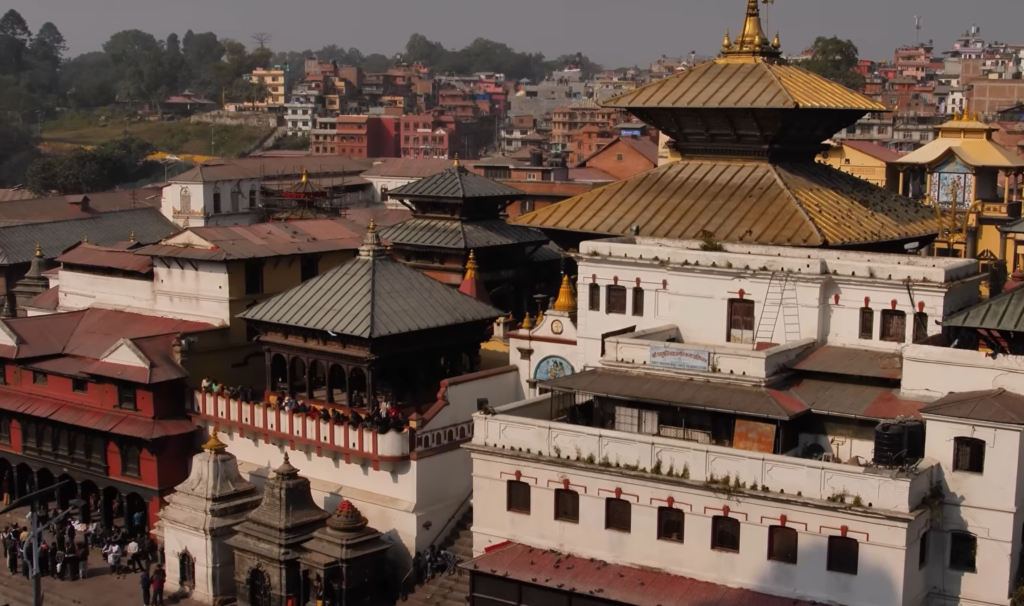
The main pagoda of Pashupatinath stands approximately 23.6 meters (about 77 feet) tall, measured from its stone platform base to the tip of its golden pinnacle. Some sources give slightly varying figures — 23.07 meters or 23.7 meters — reflecting minor differences in measurement points, but all converge on a height in the same narrow range, making the temple one of the tallest pagoda-style structures in the Kathmandu Valley.
The temple is built on a square stone platform, following the classic layout of Nepali pagoda architecture. Structurally, it consists of two roof tiers, both made of copper and gilded in gold, resting above a stone base and an intricately carved wooden superstructure. For a closer visual look at these structural details, our Architecture gallery documents the woodwork, roof tiers, and stonework in detail.
4. The Golden Roof and Silver Doors
Among the temple’s most photographed features are its gilded double-tier roof and its four silver-plated doors, one on each side of the structure, facing the cardinal directions. At the very peak of the roof sits a gold pinnacle, known as a gajur, a hallmark of Nepali pagoda temples. The roof edges and surrounding woodwork are decorated with carved deities, mythical creatures, and metal ornamentation, much of which reflects centuries of Newar craftsmanship — the indigenous artisan community of the Kathmandu Valley responsible for building and maintaining the temple for well over a thousand years.
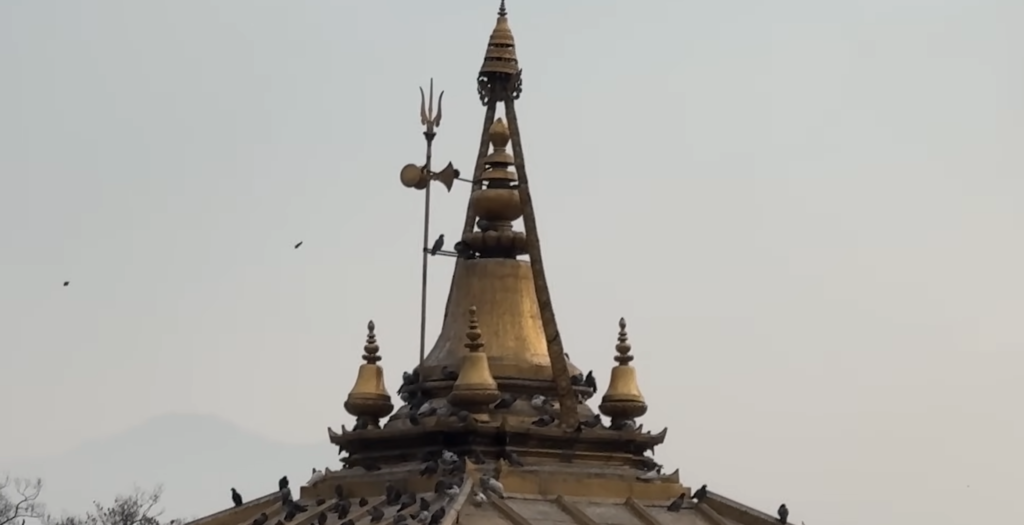
Our Temple Photos and Old Photographs galleries allow visitors to compare the temple’s appearance today with historical images spanning back more than a century, showing how remarkably consistent its design has remained even through multiple restorations.
5. The Sacred Lingam Inside the Sanctum
At the heart of the temple, within the inner sanctum (garbhagriha), sits the object of the temple’s worship: a black stone lingam known as a Chaturmukha Linga, or “four-faced lingam.” Each of the four faces looks in a cardinal direction — east, west, north, and south — while tradition holds that a fifth, unseen face looks upward toward the sky. Each face is believed to represent a different aspect of Shiva, and each is depicted holding sacred items such as a rudraksha mala (prayer beads) and a kamandalu (a ritual water vessel).
Surrounding the lingam is a silver serpent, and the sanctum itself is divided into two parts: the inner garbhagriha, which houses the sacred image and is reserved for authorized priests and Hindu worshippers, and an outer sanctum, an open corridor accessible during specific rituals. This structural division is directly tied to the temple’s access rules, which are explained fully on our Can Non-Hindus Enter? page.
6. Size of the Wider Temple Complex
While the main pagoda is the architectural centerpiece, Pashupatinath is far larger than a single building. The full temple complex spans roughly 246 hectares (about 2.46 square kilometers, or just under 1 square mile) — although some sources cite a slightly larger figure of around 264 hectares, depending on how the surrounding sacred forest and peripheral shrines are counted. Within this area sit more than 500 individual temples, shrines, ashrams, and monuments — a figure commonly cited as 518 subsidiary structures.
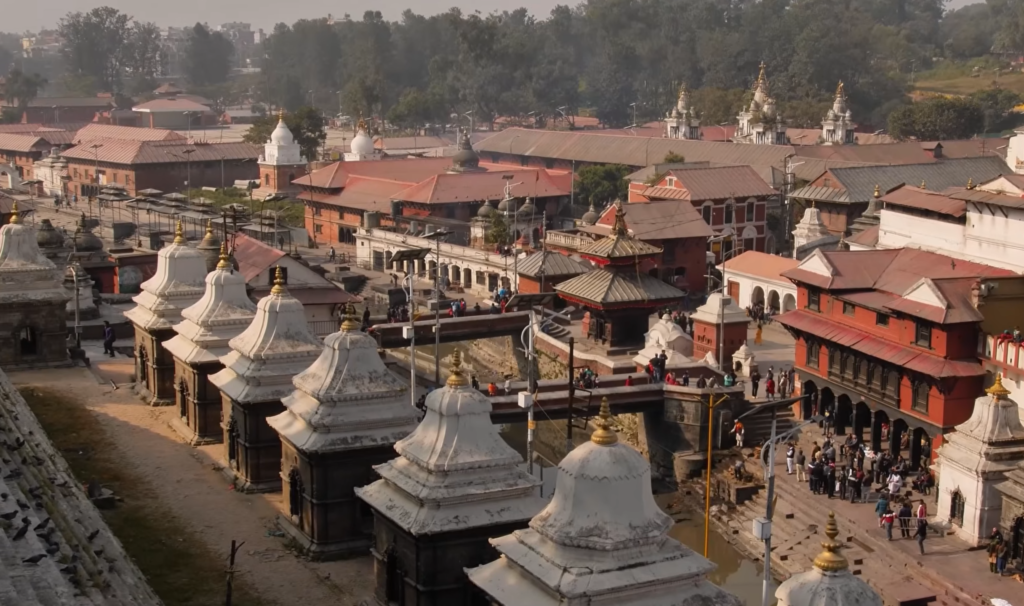
This makes Pashupatinath the largest temple complex in Nepal by a wide margin, and one of the largest Hindu temple precincts anywhere outside India. Many of these smaller shrines are dedicated to other deities, including Vishnu, Ganesh, Hanuman, and Durga, while others reflect Buddhist influence, illustrating the religious layering typical of the Kathmandu Valley. Nearby structures such as Ram Mandir and Guhyeshwari form part of this same extended sacred landscape, alongside the historic Arya Ghat. Our full Nearby Attractions guide maps out the surrounding sites in detail.
7. The Sacred Bagmati River and Cremation Ghats
The temple sits directly beside the Bagmati River, considered sacred in Hindu tradition. Along its banks are a series of ghats — stepped platforms — used for both ritual bathing and, most notably, for open-air cremation. The ghats closest to the temple are traditionally reserved for royalty and prominent public figures, while other ghats serve the general public.
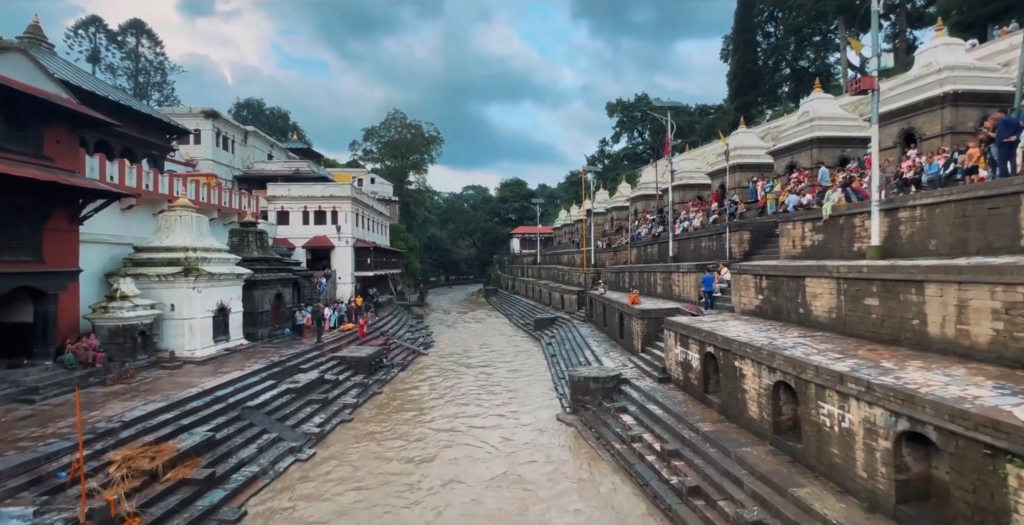
This riverside cremation tradition is a defining physical and cultural feature of Pashupatinath, and it is one of the reasons the temple attracts scholarly, journalistic, and anthropological interest well beyond its religious significance. Death rituals here are performed according to strict, centuries-old procedures, and observing them (respectfully, from designated areas) is one of the most memorable aspects of a visit, as covered in our Complete Travel Guide.
8. UNESCO World Heritage Status
Pashupatinath was formally designated a UNESCO World Heritage Site in 1979, as part of the broader Kathmandu Valley inscription, which recognizes seven monument groups across the valley for their cultural, historical, and architectural significance. UNESCO’s listing criteria for the site include cultural criteria (iii), (iv), and (vi), covering its testimony to cultural tradition, its architectural significance, and its direct association with living religious traditions and beliefs.
This international recognition, detailed further on our dedicated UNESCO World Heritage page, has helped support conservation funding and heritage protections for the temple, even as it continues to function as an active place of worship rather than a purely preserved monument.
9. Legal Protection as a National Monument
In addition to its UNESCO status, Pashupatinath is protected domestically under Nepal’s Ancient Monuments Preservation Act of 2013 (1956 in the Gregorian calendar), which governs the preservation of historically and culturally significant sites across the country. This dual layer of protection — international UNESCO recognition alongside Nepali national heritage law — reflects how seriously both the Nepali government and the global heritage community treat the site’s preservation.
10. Daily and Festival Rituals
Pashupatinath is not a static monument; it is an active temple with rituals performed every single day. The most notable of these is the evening Aarti ceremony, typically held around 6 PM, during which priests perform an elaborate sequence of lamp offerings, chanting, and prayer, drawing both devotees and visitors. Full details of these daily ceremonies are available on our Daily Puja page, while more elaborate ritual offerings — including Rudrabhishek, Maha Rudra, and Laghu Rudra — can be arranged by devotees seeking specific blessings. Our broader Rituals & Poojas section catalogs the complete range of ceremonies available at the temple.
Festivals bring the largest crowds. Maha Shivaratri, the “Great Night of Shiva,” usually falling in February or March, is by far the temple’s biggest event, drawing well over a million pilgrims and thousands of sadhus from Nepal and India in a single 24-hour period. Teej, a festival primarily observed by Hindu women for marital well-being and family prosperity, is another major annual event at the temple.
11. Visitor Access and Practical Facts
Only Hindus are permitted to enter the inner sanctum of the main temple, a policy explained in detail on our Can Non-Hindus Enter? page. Visitors of all backgrounds, however, are welcome throughout the rest of the complex, including its courtyards, secondary shrines, and riverside viewing areas. Before visiting, it’s worth reviewing our practical guides on Entry Fee, Dress Code, and Photography rules, since specific etiquette applies at a site of this religious sensitivity. Our full FAQ section answers many more commonly asked visitor questions.
For those planning logistics, our Complete Travel Guide covers everything from How to Reach the temple, navigating from Kathmandu Airport, and arranging transport through our Taxi Guide. The temple is located only a few kilometers from the airport, making it one of the most accessible major heritage sites in Kathmandu for arriving travelers. The full Travel Guide section brings all of this practical information together.
12. The Surrounding Sacred Forest
Adjacent to the main temple complex lies Shlesmantak Forest, a protected area traditionally considered sacred and closely tied to the temple’s founding legend — the story of Shiva disguised as a golden deer, detailed in our Temple Legends collection. The forest is home to deer, rhesus macaques, and numerous smaller shrines, and it forms an important ecological and spiritual buffer around the main temple precinct.
13. Priestly Lineage and Ritual Authority
Tradition holds that the priestly lineage responsible for performing rituals at Pashupatinath was established by the philosopher-saint Adi Shankaracharya, with priests historically drawn from Karnataka in South India — a detail that connects the temple’s ritual authority to a broader pan-Indian Hindu tradition rather than a purely local one. This lineage system has been maintained, with adaptations, for generations, and it underscores the temple’s standing as a site of serious theological and ritual importance, not just popular pilgrimage. Readers interested in the textual and scholarly basis for these traditions can consult our Sanskrit References and Research Papers collections.
14. Documented Scholarship and Records
Because of its age, scale, and religious importance, Pashupatinath has been the subject of extensive academic study. Historians, archaeologists, and religious scholars have documented its inscriptions, architectural evolution, and ritual practices across centuries of written record. Our Books and Research Papers sections gather much of this scholarship in one place, while our Resources hub — including a dedicated Temple Timeline resource — offers a starting point for deeper research into the temple’s documented history.
15. Fast-Reference Summary
For readers who want the essential numbers at a glance:
- Location: Kathmandu, Bagmati Province, Nepal, on the banks of the Bagmati River
- Coordinates: Approximately 27.71° N, 85.35° E
- Elevation: Roughly 817 meters (2,680 feet)
- Established: 5th century CE (current structure largely dates to 1692 CE)
- Height of main pagoda: Approximately 23.6 meters (77 feet)
- Architectural style: Two-tiered Nepali pagoda with gilded copper roofs and four silver-plated doors
- Complex area: Approximately 246–264 hectares
- Number of subsidiary shrines: Around 518
- UNESCO status: Designated in 1979, as part of the Kathmandu Valley World Heritage Site
- Main deity: Lord Shiva as Pashupati, represented by a four-faced (Chaturmukha) stone lingam
- Major festival: Maha Shivaratri, drawing well over a million pilgrims annually
A more condensed version of this list is also available on our Quick Facts page.
Conclusion
The facts surrounding Pashupatinath — its centuries-deep history, precise architectural measurements, vast complex of hundreds of shrines, and UNESCO recognition — reinforce just how extraordinary this site is, independent of belief or tradition. It is a temple whose physical scale matches its spiritual reputation: a 23.6-meter golden pagoda at the heart of a 246-hectare sacred landscape, continuously rebuilt, restored, and worshipped at for over 1,500 years. Whether you come to Pashupatinath as a pilgrim, a historian, or simply a curious traveler, these facts provide the factual backbone behind one of the most significant religious sites in the world.
Continue exploring: About Pashupatinath · Why is Pashupatinath Famous? · Spiritual Importance · UNESCO World Heritage · Temple Timeline · Quick Facts
The Pashupatinath is an independent devotional and cultural resource. It is not the official website of the Pashupati Area Development Trust (PADT) or the Government of Nepal. For official temple notices, consult PADT directly.