Darshan at Pashupatinath ; the act of viewing and spiritually connecting with the temple’s sacred four-faced lingam follows a structured daily rhythm built around a pre-dawn Mangala Aarti, a mid-morning ritual bathing of the deity, a midday closure, and an evening Sandhya Aarti, all set within a complex where entry to the inner sanctum is reserved for Hindu, Buddhist, Sikh, and Jain devotees while the wider precinct remains open to all visitors.
Unlike some major Indian temples, Pashupatinath has no official online darshan booking system, no government-run VIP ticket, and no guaranteed way to skip the queue meaning a successful, unhurried darshan depends almost entirely on understanding the temple’s actual daily schedule and timing your visit around it. This guide walks through exactly how darshan works at Pashupatinath, from the moment the gates open to the final evening aarti on the riverbank.
This entry is part of our Darshan Guide. For the temple’s broader history and religious background, see What is Pashupatinath? and Spiritual Importance; for its physical layout, see Temple Map and Temple Complex.
Quick Answer
| Complex hours | 4:00 AM – 9:00 PM daily |
|---|---|
| Inner sanctum darshan hours | Roughly 5:00 AM – 12:00 PM and 5:00 PM – 7:00/7:30 PM |
| Midday closure | Approximately 12:00 PM – 5:00 PM |
| Mangala Aarti (pre-dawn worship) | Around 4:30–5:00 AM |
| Sandhya Aarti (evening worship) | Around 6:00–7:00 PM |
| Bagmati Ganga Aarti (riverbank) | Around 6:00–7:30 PM daily |
| Entry fee — Nepali and Indian nationals | Free |
| Entry fee — other foreign nationals | Approximately NPR 1,000 |
| Typical darshan wait time | 90–180 minutes, depending on crowd |
| Online darshan booking | Not officially available |
| Who may enter the inner sanctum | Hindus, Buddhists, and, per temple custom, Sikhs and Jains of Indian origin |
| Photography inside the sanctum | Strictly prohibited |
What “Darshan” Means at Pashupatinath
Darshan — from the Sanskrit meaning “sight” or “viewing” — refers to the act of beholding a deity’s image, understood in Hindu practice not as passive observation but as a reciprocal, spiritually significant exchange: the devotee sees the deity, and the deity is understood to see and bless the devotee in turn. At Pashupatinath, darshan centers on viewing the temple’s sacred Chaturmukha lingam, the four-faced image of Shiva as Pashupati enshrined at the heart of the sanctum, discussed in full detail in our companion entries on the Four Faces of Pashupatinath and the Shiva Linga more broadly.
Because access to the inner sanctum is restricted, darshan at Pashupatinath takes a specific physical form for most devotees: viewing the lingam and the priests’ rituals from within the courtyard surrounding the sanctum, rather than standing directly before the image itself as at some more openly accessible temples. Understanding this structure in advance — rather than expecting an experience identical to other Hindu temples — is one of the most useful things a first-time visitor can know before arriving.
The Complete Daily Darshan Schedule
Pashupatinath’s ritual day follows a fairly consistent structure, though small variations in exact timing appear across different sources and can shift slightly by season or on specific festival dates. The general daily sequence is as follows:
| Time (approximate) | Activity |
|---|---|
| 4:00 AM | Temple complex opens; priests begin preparing the sanctum |
| 4:30–5:00 AM | Mangala Aarti — the first, pre-dawn worship of the day, widely regarded as the most spiritually charged and least crowded darshan opportunity |
| 5:00 AM–9:30 AM | Morning darshan continues; devotees may view the sanctum from the courtyard |
| ~9:30 AM | Ritual bathing (abhisheka) of the lingam |
| 9:30–11:30 AM | Special pujas continue |
| 12:00–12:30 PM | Baal Bhog offering presented to the deity |
| 12:00/12:30 PM–5:00 PM | Midday closure — the inner sanctum is generally closed to public darshan during this window |
| 1:30 PM | Mul Bhog presentation (occurs within the closure period, as part of the deity’s ritual “rest”) |
| 5:00 PM | Sanctum reopens for evening darshan |
| 5:00–7:00 PM | Evening darshan continues |
| 6:00–7:00/7:30 PM | Sandhya Aarti — the main evening worship inside the temple, and the Bagmati Ganga Aarti performed simultaneously on the riverbank facing the water |
| 9:00 PM | Complex closes for the night |
Because exact timings can shift by season, festival calendar, or specific temple announcement, visitors planning around a precise window — particularly the Mangala Aarti or Sandhya Aarti — should confirm the current schedule locally or through their accommodation on the day of the visit rather than relying solely on any single published source, including this one.
Who Can Do Darshan: Entry Rules Explained
Pashupatinath’s entry policy is more specific than a simple “Hindus only” rule, and understanding the actual distinctions can prevent confusion on arrival:
- Hindus of any nationality are permitted to enter the inner sanctum for darshan.
- Buddhists, particularly those of Nepali and Tibetan tradition, are generally permitted entry, reflecting the historical overlap between Hindu and Buddhist devotional practice in the Kathmandu Valley.
- Sikhs and Jains of Indian origin are, per longstanding temple custom, generally permitted entry as well.
- Non-Hindu foreign visitors are not permitted into the inner sanctum but may freely explore the entire outer complex, including the courtyard perimeter, the cremation ghats, the Mrigasthali deer sanctuary, and the eastern-bank viewing terraces — see Can Non-Hindus Enter? for the full policy.
In practice, temple staff generally make this determination through brief questioning or visual assessment at the inner gate rather than requiring formal documentation, though visitors should expect this determination to be made at the temple’s discretion and should not attempt to circumvent it.
Step-by-Step: How to Do Darshan at Pashupatinath
For devotees eligible to enter the inner sanctum, a typical darshan visit generally follows this sequence:
- Arrive early, ideally before or shortly after the complex opens at 4:00 AM if aiming for the Mangala Aarti, or well before the midday closure otherwise.
- Pass through security at the main western gate, including bag checks and metal detectors; electronic gadgets, including phones and cameras, are generally restricted within the inner courtyard and should be minimized or left secured.
- Remove footwear at the designated shoe-keeping area before entering the temple’s fortified inner courtyard.
- Join the darshan queue. On ordinary days, waiting times typically range from roughly 90 minutes to 3 hours depending on crowd volume; queues are significantly longer during festivals and auspicious lunar dates.
- Proceed through the courtyard, passing subsidiary shrines such as the Vasuki Nath Temple, Ganesh Temple, and the Nandi statue, before approaching the main sanctum.
- View the sanctum and the four-faced lingam from the permitted viewing area within the courtyard, where priests can typically be observed performing ongoing rituals.
- Make offerings, if desired, at designated points — common offerings include flowers, bel (bilva) leaves, and monetary donations, generally handled through temple staff or priests rather than placed directly by visitors.
- Exit via the designated route, collecting footwear and any secured belongings on the way out.
For devotees interested in witnessing the temple’s other core rituals in detail, see our Daily Puja, Rudrabhishek, Maha Rudra, and Laghu Rudra pages.
Entry Fees and Tickets
Pashupatinath’s fee structure is straightforward but worth confirming before travel, since figures are occasionally updated by Nepali authorities:
- Nepali and Indian nationals enter free of charge.
- Other foreign nationals typically pay an entry fee of approximately NPR 1,000, generally collected at a ticket counter near the main entrance.
- There is no official government or temple-run online booking system for darshan tickets, in contrast to some major Indian temples that offer paid online slot reservations.
- Visitors should be cautious of third-party websites or individuals claiming to sell “guaranteed” official darshan tickets or reserved entry slots online; the safest approach is paying the standard entry fee in person at the temple.
For complete visitor fee details, see Entry Fee in our FAQ section.
VIP and Special Darshan: What’s Actually Available
Because several major Hindu temples across South Asia offer formal, government-administered VIP or “Sheegra” (expedited) darshan tickets for an additional fee, it’s worth being precise about what Pashupatinath does and does not offer. Pashupatinath Temple itself does not run an official VIP darshan ticketing system. What does exist are privately organized tour packages, offered by travel agencies and tour operators, advertising “VIP darshan,” priority access, or reduced queue time, typically bundled with broader Nepal pilgrimage itineraries and arranged through the operator’s local connections and relationships rather than an official temple mechanism.
Visitors considering such packages should treat them as third-party travel arrangements rather than official temple services, and should research the specific operator’s reputation carefully before booking. For most visitors, arriving during a lower-traffic window — particularly the early Mangala Aarti — remains the most reliable, cost-free way to experience a relatively unhurried darshan.
Dress Code and What to Bring
Pashupatinath maintains modest dress expectations consistent with its status as an active place of worship:
- Cover shoulders and knees; loose, modest clothing is generally appropriate for all visitors, regardless of gender.
- Remove leather items where required, particularly before entering restricted areas, consistent with broader Hindu temple custom regarding animal-derived materials.
- Bring a small bag for storing footwear, or use the designated shoe-keeping facilities at the entrance.
- Minimize electronics. Cameras and phones are frequently restricted within the inner courtyard and are never permitted for photography inside the sanctum itself.
- Carry cash in small denominations for the entry fee (if applicable) and any voluntary offerings.
For the complete dress code policy, see Dress Code; for photography rules specifically, see Photography.
Best Times for a Peaceful Darshan
Timing a visit strategically makes a substantial difference to the overall darshan experience:
- The Mangala Aarti (roughly 4:30–5:00 AM) consistently offers the calmest, least crowded, and most spiritually immersive darshan window of the day, though it requires a genuinely early start.
- Weekday mornings outside festival dates are generally quieter than weekends.
- Ekadashi, the eleventh day of each lunar fortnight (occurring roughly twice monthly), draws noticeably larger crowds and is worth avoiding for visitors specifically seeking a quiet experience.
- October through December, and separately February and March, are commonly cited as the most pleasant months weather-wise for a Kathmandu Valley visit generally, though March also brings Maha Shivaratri’s enormous crowds specifically to Pashupatinath.
For broader seasonal travel planning, see our Travel Guide.
Darshan During Major Festivals
Pashupatinath’s darshan experience changes considerably during its major festival dates, and visitors should plan accordingly:
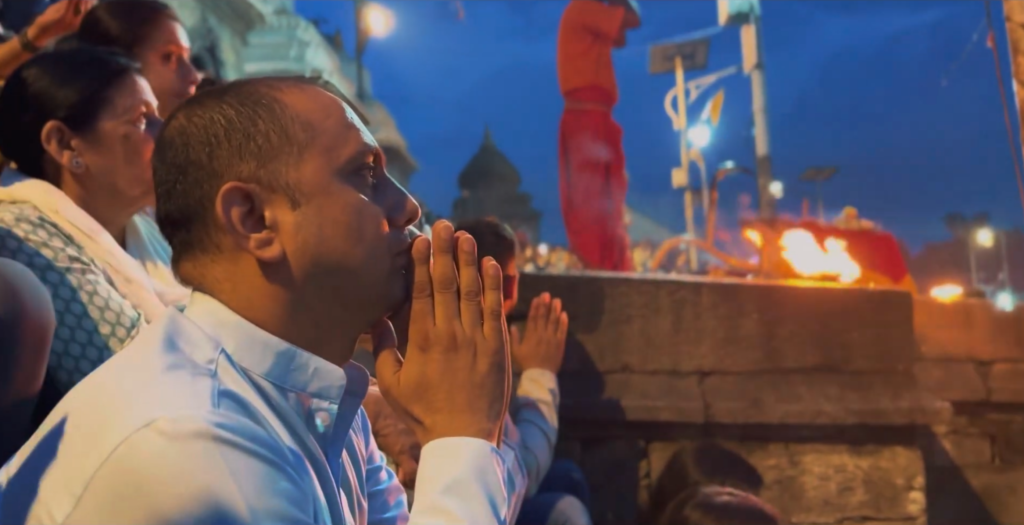
- Maha Shivaratri (February/March) — Nepal’s largest Shiva festival and by far Pashupatinath’s busiest single event, drawing well over a million pilgrims across the festival period. The temple opens as early as 3:00 AM on this date specifically, all four gates are typically opened simultaneously, and multiple queue lines are organized to manage the enormous crowd. Darshan wait times extend far beyond the typical 90–180 minute range, and visitors should expect a dramatically different, far more intense atmosphere than an ordinary day. See Why is Pashupatinath Famous? for more on this festival’s scale.
- Teej (August/September) — a major festival primarily observed by Hindu women, during which the temple fills with devotees dressed in red sarees, creating a visually striking but also significantly more crowded darshan environment.
- Ekadashi (monthly) — occurring on the eleventh day of each lunar fortnight, this recurring observance draws noticeably larger-than-usual crowds every two weeks, worth factoring into travel plans even outside the major annual festivals.
For the complete festival calendar and ritual details, see our Rituals & Poojas section.
What You’ll See During Darshan
For visitors unfamiliar with what actually happens during a Pashupatinath darshan, the experience typically includes:
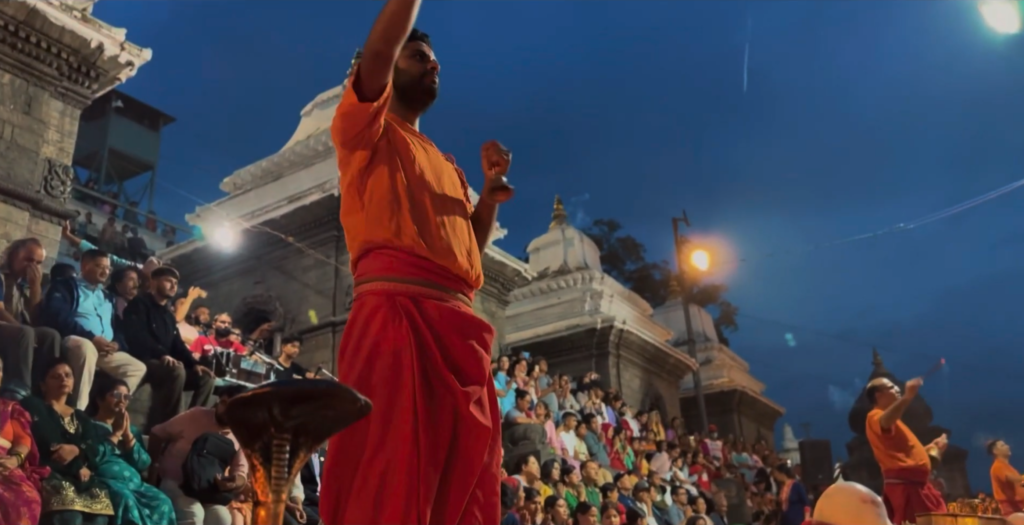
- The four-faced lingam itself, visible from the courtyard, generally dressed in golden ceremonial vestments except during ritual bathing.
- Bhatta priests performing active rituals — bathing, dressing, and making offerings to the deity according to a precise, centuries-old sequence.
- Chanting, bells, and the rhythmic sound of ritual drums, particularly pronounced during the Mangala and Sandhya Aarti.
- A visibly devout, often emotional atmosphere, especially during major aarti moments, as devotees offer prayers, prostrations, and personal petitions.
- The distinctive scent of incense, ghee lamps, and flower offerings, layered throughout the courtyard.
For the deeper mythological and theological context behind what’s being worshipped, see our entries on the Five Faces of Pashupatinath and the Mythology of Lord Pashupati and Pashupatinath.
After Darshan: What to See Nearby
Most visitors extend a Pashupatinath visit beyond the inner sanctum darshan itself. Popular next stops within the wider complex and immediate area include:
- The cremation ghats, particularly Aryaghat, viewable respectfully from a distance.
- Guhyeshwari Temple, across the Bagmati River, considered a natural continuation of the same pilgrimage. See Guhyeshwari.
- Gorakhnath Temple, on the hilltop above the eastern ghats, offering panoramic views of the complex.
- Mrigasthali, the forested deer sanctuary tied to the temple’s origin legend.
- Boudhanath Stupa, a short distance away and commonly combined with a Pashupatinath visit in a single day’s itinerary. See Boudhanath.
For a complete route recommendation covering both riverbanks, see our Temple Map page.
Special Considerations: Families, Elderly Visitors, and Accessibility
A few practical notes worth planning around, particularly for visitors traveling with children, elderly family members, or mobility considerations:
- Standing time can be significant. Because darshan queues frequently run 90 minutes or longer, elderly visitors or those with mobility limitations should plan for the physical demands of extended standing, and consider arriving during quieter windows (such as the Mangala Aarti or a weekday outside festival dates) to minimize wait times.
- The complex involves considerable walking. Between the inner courtyard, the ghats, and any crossing to the eastern bank, a full visit can involve well over a kilometer of walking across uneven, historic stone surfaces — worth factoring in for visitors with limited mobility.
- Children are welcome throughout the complex, though the crowded, emotionally intense atmosphere near the cremation ghats in particular may warrant guardians’ judgment about what young children should observe closely.
- Restrooms and amenities within the immediate temple precinct are limited compared to a typical modern tourist attraction; visitors should plan accordingly, particularly for longer visits spanning both riverbanks.
- Heat and crowding during festivals can be physically demanding; visitors attending Maha Shivaratri or Teej specifically should bring water, dress for extended outdoor time, and set realistic expectations about pace and comfort given the scale of the crowds.
Hiring a Guide for Darshan
Because Pashupatinath’s ritual sequence, mythology, and layout are genuinely intricate — as reflected throughout this guide — many first-time visitors, particularly non-Hindu tourists restricted to the outer complex, find that a local guide meaningfully improves the visit, explaining rituals in progress, pointing out specific shrines described in our Temple Directory, and offering real-time context that static signage does not provide. Guides are commonly available near the main entrance and through hotels or tour operators in Kathmandu.
When engaging an independent guide on-site, a few practical precautions are worth keeping in mind: agree on a price and the scope of the tour before beginning, confirm whether the guide is licensed or affiliated with a recognized tourism body if that matters to you, and treat any guide’s claim of being able to arrange “special access” to the restricted inner sanctum with appropriate skepticism, since entry restrictions are a matter of consistent temple policy rather than something a private guide can override.
Common Mistakes First-Time Visitors Make
A few recurring issues are worth flagging directly:
- Arriving during the midday closure. Visitors unfamiliar with the roughly 12:00–5:00 PM break sometimes arrive expecting continuous access and are surprised to find the inner sanctum closed for several hours.
- Expecting an online booking option. Because some other major temples offer paid online darshan slots, visitors occasionally search for — and fail to find — an equivalent official system at Pashupatinath, which does not exist.
- Bringing prohibited electronics into the inner courtyard, leading to confiscation or the need to backtrack to secure storage.
- Underestimating festival crowds, particularly around Maha Shivaratri, and arriving without the extra time such dates require.
- Assuming non-Hindu status is negotiable. Entry restrictions to the inner sanctum are consistently enforced, and visitors should not expect exceptions regardless of interest or intent.
Frequently Asked Questions
What time should I arrive for the best darshan experience at Pashupatinath?
Arriving for the Mangala Aarti, around 4:30–5:00 AM, offers the calmest and most spiritually immersive darshan window, with significantly smaller crowds than later in the day.
Is there an online booking system for Pashupatinath darshan?
No. Unlike some major Indian temples, Pashupatinath does not offer an official online darshan booking or VIP ticketing system; entry is managed in person at the temple.
How long is the wait time for darshan at Pashupatinath?
Typically 90 minutes to 3 hours on an ordinary day, depending on crowd levels, and considerably longer during major festivals such as Maha Shivaratri.
Can non-Hindus do darshan at Pashupatinath?
Non-Hindus cannot enter the inner sanctum but can visit the entire surrounding complex, including the ghats, Mrigasthali deer sanctuary, and eastern-bank viewing terraces.
What is the entry fee for darshan?
Free for Nepali and Indian nationals; approximately NPR 1,000 for other foreign nationals.
Is photography allowed during darshan?
No. Photography is strictly prohibited inside the sanctum and generally restricted throughout much of the inner courtyard.
What should I wear for darshan at Pashupatinath?
Modest clothing covering the shoulders and knees is expected of all visitors, regardless of gender or religious background.
For more direct answers, see our full FAQ section.
Can I make offerings during darshan, and what is appropriate?
Yes — common offerings include flowers, bel (bilva) leaves, and monetary donations, generally handled through temple priests or designated staff rather than placed directly on the lingam by visitors themselves.
Is Pashupatinath crowded every day, or only during festivals?
Ordinary days see a steady but generally manageable flow of devotees, with wait times in the 90-minute-to-3-hour range; crowd levels rise predictably around Ekadashi dates and rise dramatically during major festivals such as Maha Shivaratri and Teej.
Where to Go Next
- What is Pashupatinath? — foundational facts about the temple and its deity
- Four Faces of Pashupatinath and Five Faces of Pashupatinath — what the lingam you’ll see during darshan actually represents
- Temple Map and Temple Complex — the physical layout of the site
- Rituals & Poojas, including Daily Puja, Rudrabhishek, Maha Rudra, and Laghu Rudra — detailed ritual explanations
- Can Non-Hindus Enter?, Entry Fee, Dress Code, and Photography — full visitor policy details
- Travel Guide, How to Reach, and Taxi Guide — practical transport planning
- Guhyeshwari and Boudhanath — nearby sites commonly visited alongside Pashupatinath
This entry is part of our Darshan Guide, covering practical, ritual, and spiritual guidance for visiting Pashupatinath Temple.
The Pashupatinath is an independent devotional and cultural resource. It is not the official website of the Pashupati Area Development Trust (PADT) or the Government of Nepal. For official temple notices, consult PADT directly.