Pashupatinath is one of the holiest Hindu temples in the world — a sprawling temple complex dedicated to Lord Shiva in his form as Pashupati, “Lord of All Living Beings.” Located on the banks of the sacred Bagmati River in Kathmandu, Nepal, it is a UNESCO World Heritage Site, Nepal’s most important pilgrimage destination, and one of the four holiest Shiva shrines (Char Dham) recognized across the subcontinent. For over a thousand years, Pashupatinath has served simultaneously as a place of worship, a center of cremation and mourning, a residence for wandering ascetics, and a living museum of Nepali pagoda architecture — making it far more than a single building. It is an entire sacred district.
This entry lays out the essential facts: what Pashupatinath is, where it stands, what the name means, why Hindus consider it so significant, what the temple looks like, and how it fits into the broader story of Kathmandu Valley. For deeper dives, see our dedicated guides on Why is Pashupatinath Famous?, Spiritual Importance, and Temple Facts.
Quick Answer
| Also known as | Pashupatinath Temple, Pashupati Mandir, Shree Pashupatinath |
|---|---|
| Deity | Lord Shiva, worshipped as Pashupati (“Lord of Animals” / “Lord of All Living Beings”) |
| Location | Deopatan, on the banks of the Bagmati River, eastern Kathmandu, Nepal |
| Religion | Hinduism (Shaivism) |
| Architectural style | Nepalese pagoda |
| UNESCO status | Inscribed in 1979, as part of the Kathmandu Valley World Heritage Site |
| Complex size | Roughly 246 hectares, containing more than 500 individual temples and shrines |
| Entry restriction | The inner sanctum is open to Hindus only; the wider complex, ghats, and viewing areas are open to all visitors |
| Best known for | The main pagoda temple, the Aryaghat cremation ghats, resident sadhus, and the annual Maha Shivaratri festival |
For a longer breakdown of numbers and statistics, see Quick Facts and Temple Facts.
The Short Definition
At its simplest, Pashupatinath is a Hindu temple complex. But that description undersells what the site actually is. Pashupatinath is:
- A temple — the main pagoda houses a sacred Shiva lingam and is one of the most revered Shiva shrines on the subcontinent.
- A cremation ground — the ghats along the Bagmati River, most famously Aryaghat, are where many Hindus in Nepal are cremated, following a belief that dying and being cremated beside the sacred river brings liberation (moksha).
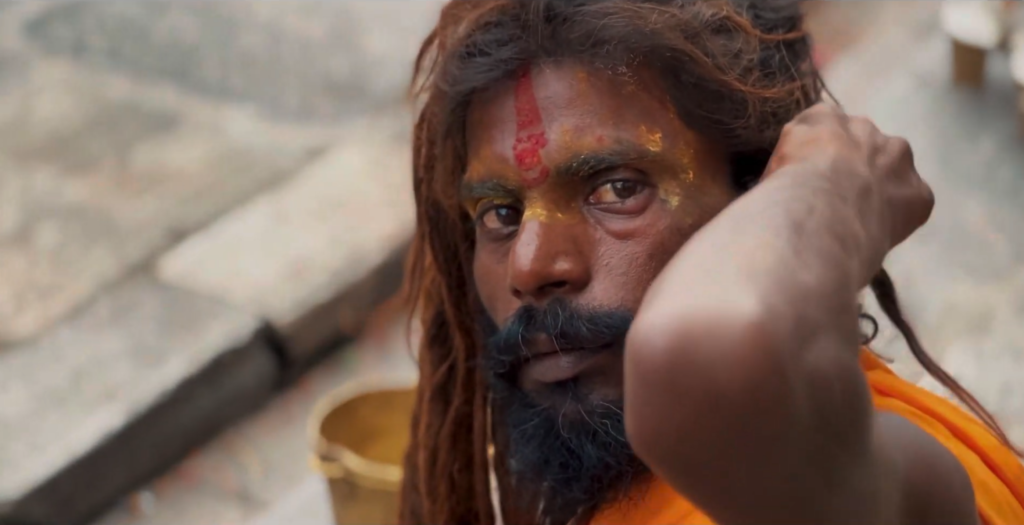
- A religious community — hundreds of sadhus (Hindu holy men), many of them ash-smeared renunciates following Shaiva traditions, live in and around the complex, some part of organized ashrams and others as wandering ascetics.
- A festival ground — the site becomes the epicenter of Nepal’s largest religious gathering during Maha Shivaratri, when hundreds of thousands of pilgrims arrive from Nepal and India.
- A UNESCO World Heritage Site — recognized in 1979 as part of the wider Kathmandu Valley inscription, protected for its historical, architectural, and living cultural value.
- A national symbol — Pashupatinath functions as something close to a national shrine for Nepal, historically tied to the monarchy and now central to Nepali religious identity regardless of political changes.
Because it combines all of these roles in a single, continuously used site, scholars often describe Pashupatinath as one of the world’s few “living heritage” sites — a place where ancient ritual, architecture, and daily life have never stopped overlapping.
What Does “Pashupatinath” Mean?
The name Pashupatinath comes from Sanskrit and breaks down into three parts:
- Pashu — meaning “animal” or, more broadly, “living being” (in some interpretations, including the human soul bound by ignorance)
- Pati — meaning “lord,” “master,” or “protector”
- Nath — an honorific meaning “lord” or “master,” commonly added to the names of Shiva and other deities in North Indian and Nepali devotional traditions
Put together, Pashupatinath translates to something like “Lord of All Living Beings” or “Protector of Animals.” Within Shaivism, this is understood not literally as a god of wildlife, but symbolically: Shiva as Pashupati is the master who liberates all bound souls (the “pashu”) from the cycle of ignorance, desire, and rebirth. This is one of Shiva’s oldest recorded epithets in Indian religious history, with roots tracing back to Vedic-era literature describing Rudra — an early, fierce form of Shiva — as a herder and protector of creatures.
Because of this etymology, Pashupatinath is frequently described in devotional texts and temple inscriptions as Pashupati, with “-nath” added as a mark of reverence, similar to how other major Shiva temples across South Asia use “-nath” in their names (Kedarnath, Vishwanath, Amarnath, and others).
Where Is Pashupatinath Located?
Pashupatinath sits in Deopatan, a historic settlement on the eastern edge of Kathmandu, Nepal, roughly 5 kilometers from the city center and only a few kilometers from Tribhuvan International Airport — making it one of the most accessible major pilgrimage sites in South Asia. The temple straddles both banks of the Bagmati River, a tributary considered sacred in its own right and central to nearly every ritual performed at the site.
The broader Kathmandu Valley, in which Pashupatinath sits, is itself one of the densest concentrations of temples, monasteries, and heritage architecture anywhere in the world — a legacy of successive dynasties (Licchavi, Malla, Shah, and Rana) who each expanded and patronized the valley’s religious sites. Pashupatinath’s location on the Bagmati places it in direct proximity to several other major religious sites, including Guhyeshwari Temple, Boudhanath Stupa, and the deer sanctuary at Mrigasthali, all of which are tied to Pashupatinath through shared mythology. See Nearby Attractions for the full list, including Guhyeshwari, Boudhanath, and Arya Ghat.
For directions, transport options, and airport distance, see our Travel Guide and How to Reach pages.
Who Is Worshipped at Pashupatinath?
The presiding deity is Lord Shiva, one of the three principal gods of Hinduism (alongside Brahma and Vishnu) and, within Shaivism specifically, considered the Supreme Being. At Pashupatinath, Shiva is worshipped in his Pashupati form — not through an anthropomorphic idol, but through a sacred lingam, an abstract cylindrical form that represents Shiva in his formless, universal aspect.
The lingam inside the main sanctum is distinctive: it is described in temple tradition as four-faced (Chaturmukha), with each face representing a different aspect or manifestation of Shiva, oriented toward the cardinal directions, and a fifth, formless aspect said to face upward. This multi-faced representation is one of the reasons Pashupatinath’s central image is considered unique among Shiva shrines, distinguishing it from the aniconic single-form lingams found in many other temples.
Devotees consider Pashupatinath one of the most important of Shiva’s manifestations anywhere in the world, alongside the twelve Jyotirlingas of India and other major Shaiva pilgrimage centers. For the full scriptural and legendary background — including the well-known story of Shiva hiding in the forest as a golden deer — see our Mythology pillar page.
Why Pashupatinath Matters in Hinduism
Pashupatinath’s importance rests on several overlapping ideas within Hindu belief and practice:
1. It is considered one of the holiest Shiva shrines in existence
Within Shaiva tradition, Pashupatinath ranks among the most sacred sites associated with Shiva anywhere in the subcontinent, often placed in the same conversation as Kedarnath, Kashi Vishwanath, and the Jyotirlingas.
2. It completes the Char Dham pilgrimage, in some traditions
Certain devotional traditions hold that a pilgrim’s spiritual journey is incomplete without a visit to Pashupatinath, treating it as an essential stop alongside India’s major Char Dham sites — reflecting the temple’s stature beyond Nepal’s borders.
3. It is a preferred site for death and cremation
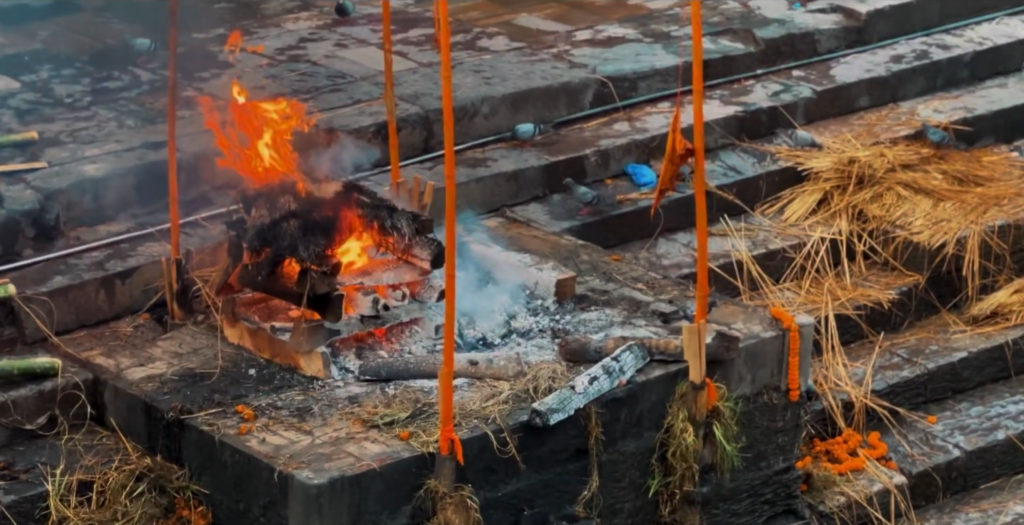
Hindu belief holds that dying near a sacred river, and being cremated on its banks, aids the soul’s liberation. Because of this, many devout Hindus — including some who are terminally ill — travel to Pashupatinath specifically to spend their final days near the temple, and cremations take place daily along the Bagmati’s ghats. This single belief is central to understanding why Pashupatinath feels different from most other major temples: it is simultaneously a place of festive worship and quiet mourning, often within view of one another.
4. It anchors Nepal’s religious and national identity
Long associated with the royal house of Nepal and considered the country’s guardian deity in some traditions, Pashupatinath has functioned historically as more than a place of personal devotion — it has been treated as a protector of the Nepali state itself, a role that persists culturally even after Nepal’s transition away from monarchy.
A fuller discussion of these themes is available on our Spiritual Importance page.
What Does the Temple Complex Actually Look Like?
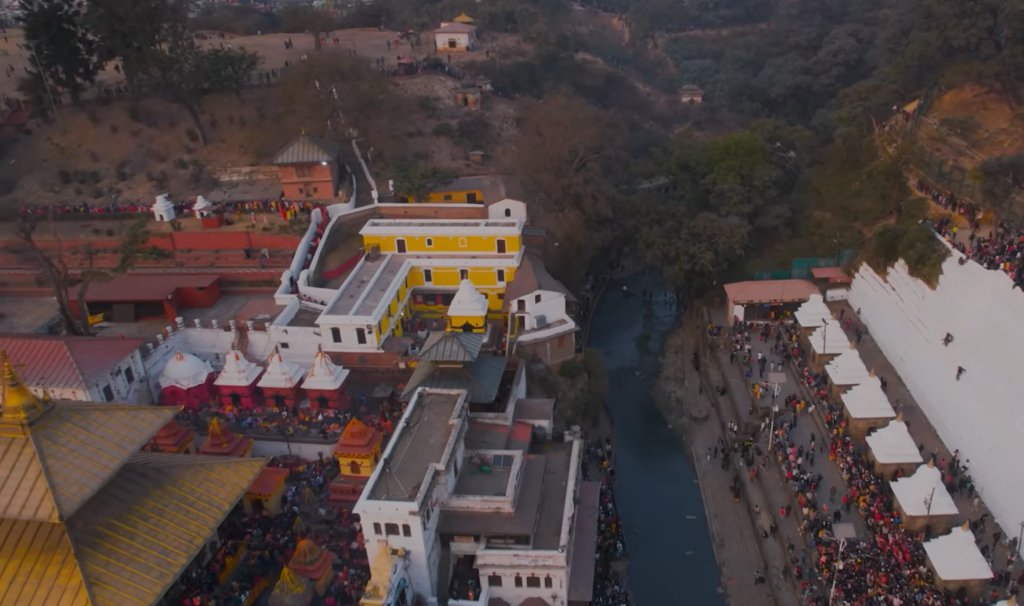
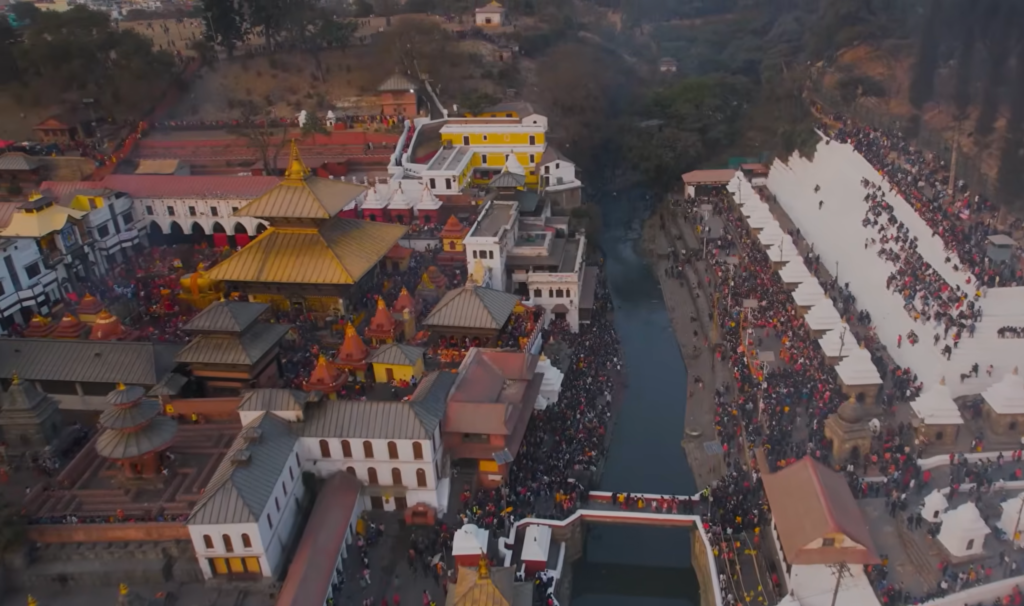
Unlike many temples that consist of a single structure, Pashupatinath is best understood as a precinct — a network of temples, courtyards, ghats, ashrams, and shrines spread across roughly 246 hectares along both banks of the Bagmati. Estimates place the number of individual temples, shrines, and monuments within the complex at over 500, ranging from small stone shivalingas tucked into courtyards to substantial standalone temples.
The Main Pagoda Temple
The central and most recognizable structure is the main pagoda-style temple housing the Pashupati lingam. It is built in the classic Nepalese pagoda style: a tiered, sloping roof structure rather than the spire-topped shikhara style common in North Indian temple architecture. Key features include:
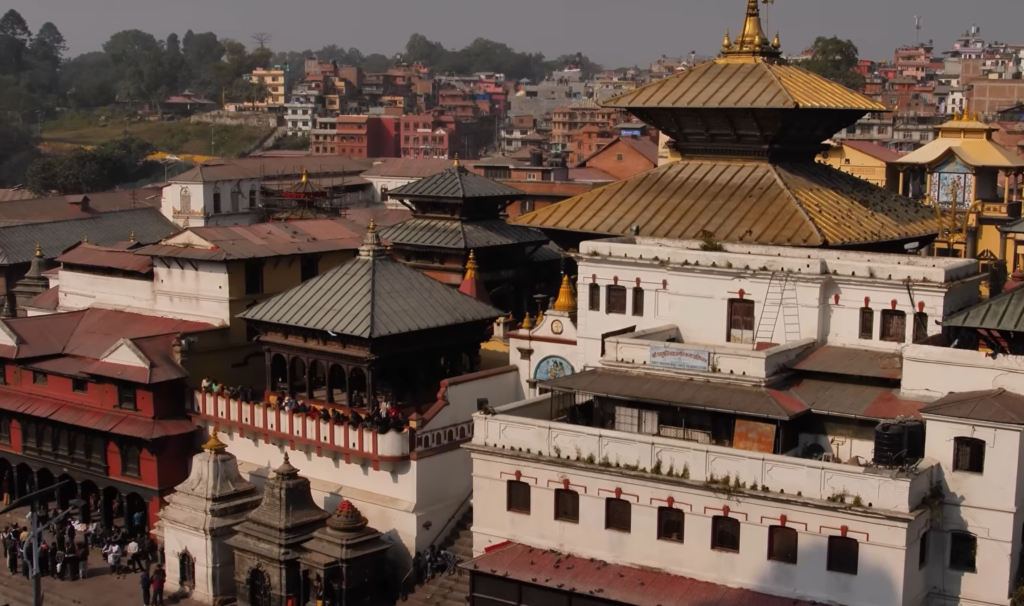
- A two-tiered copper roof, gilded in gold
- A cubic sanctum with four heavily ornamented doors, each covered in silver sheeting
- Richly carved wooden struts (tundal) supporting the roof, depicting deities and mythological scenes
- A gold pinnacle (gajura) at the top of the structure
The Ghats
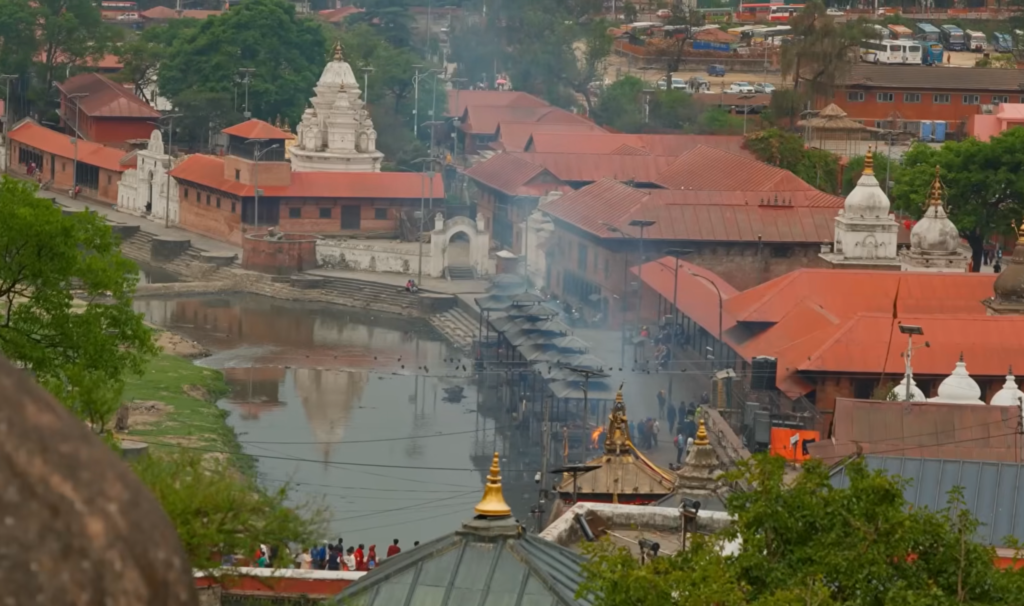
The stone steps and platforms lining the Bagmati River are used for both ritual bathing and cremation. Aryaghat, closest to the main temple, is reserved for cremating members of the royal family and other dignitaries historically, while adjoining ghats serve the general public.
Ancillary Temples and Shrines
Scattered throughout the complex are hundreds of smaller shrines, many dedicated to other deities associated with Shiva’s mythology, along with dharamshalas (rest houses for pilgrims), ashrams for resident sadhus, and inscriptions dating back over a thousand years.
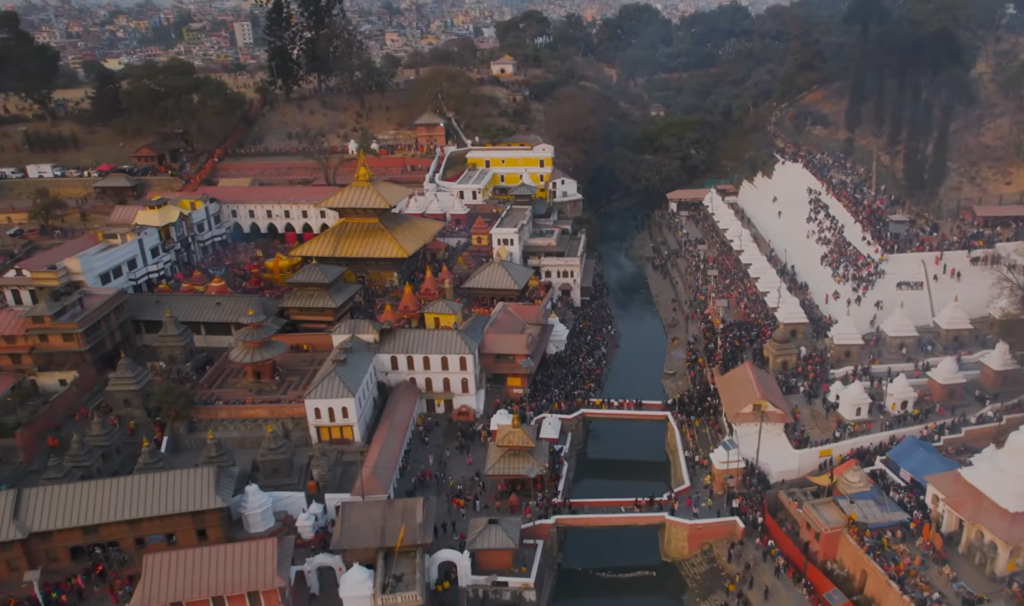
For a full structural breakdown with maps, see our Temple Complex pillar page and the interactive Temple Map.
Who Runs Pashupatinath? Priests and Administration
Daily worship inside the sanctum is conducted by hereditary priests known as Bhatta priests, a tradition with roots going back centuries and, by long-standing custom, drawn from South India rather than Nepal — a practice tied to a historical belief that priests from outside the local community would perform rituals with greater impartiality and purity. This arrangement has occasionally become a point of public debate; in 2009, for instance, a dispute arose over the appointment of local priests in place of the traditional Bhatta lineage, which led to protests and an eventual court ruling reinstating the customary practice. Episodes like this illustrate that Pashupatinath is not a frozen museum piece but a living institution with ongoing questions of governance, tradition, and change.
Overall administration of the temple complex, its finances, conservation work, and ritual calendar falls under the Pashupati Area Development Trust (PADT), a government-linked body established to manage the site, coordinate with UNESCO on heritage conservation, and oversee the daily logistics of hosting enormous numbers of pilgrims, particularly during festivals. For a directory of temples, trusts, and functional areas within the complex, see our Temple Directory.
A Brief Word on History
The origins of worship at Pashupatinath are difficult to date precisely, and popular accounts often blend documented history with legend. What can be said with reasonable confidence:
- Religious activity at the site likely predates any surviving structure, with some traditions placing devotional use of the location well before the Common Era.
- The earliest securely dated references to a Pashupatinath temple come from Licchavi-era inscriptions, with textual sources pointing to temple activity by around the 5th century CE.
- Nepali chronicles (vamshavalis) describe the temple being rebuilt and expanded multiple times by successive rulers — Licchavi kings, later Malla kings, and eventually the Shah dynasty — often after damage from fire, earthquake, or natural decay of earlier wooden structures.
- The current stone-and-copper structure, the one visitors see today, dates largely from renovations carried out during the Malla period, with continued patronage under later dynasties.
- The site was inscribed as a UNESCO World Heritage Site in 1979, as one component of the broader Kathmandu Valley World Heritage designation, which also includes Durbar Squares, Swayambhunath, and Boudhanath.
This entry only sketches the historical timeline; the full narrative — including specific kings, reconstructions, and the transition through the Kirat, Licchavi, Malla, Shah, and Rana eras — is covered in depth on our History pillar page and Temple Timeline.
The Mythological Origin Story
Alongside its documented history, Pashupatinath carries a rich mythological origin, central to why Hindus consider the location itself sacred, independent of any structure built on it. The most widely told version involves Shiva and Parvati taking the form of deer and living contentedly in the forests along the Bagmati. When other gods eventually located Shiva and persuaded him to resume his cosmic duties, he fled, and in the ensuing pursuit, one of his horns is said to have broken off and later re-emerged from the ground as a jyotirlinga — a self-manifested symbol of light — at the site where the temple now stands.
This story explains several features of the surrounding area still referenced today, including the Mrigasthali deer sanctuary near the temple and the tradition of deer being treated as sacred animals within the complex. It also reinforces the “Pashu” root of the temple’s name, tying Shiva’s identity as “Lord of Animals” directly to this local legend.
A separate but related tradition holds that the golden lingam was later discovered by cattle herders after one of their cows was seen pouring milk over a particular spot of earth — a discovery story that appears in multiple regional variants and is echoed in the founding legends of other Shiva temples across South Asia.
Full versions of these stories, along with related legends about saints and kings connected to the temple, are available in our Mythology section and in Temple Legends.
How Pashupatinath Compares to Other Major Shiva Temples
Because Hinduism has many revered Shiva sites, it helps to see where Pashupatinath fits among them:
- The Jyotirlingas (India) — twelve sites across India, including Kedarnath, Somnath, and Kashi Vishwanath, considered self-manifested forms of Shiva’s radiant light. Pashupatinath is not formally counted among the twelve Jyotirlingas, but its lingam is regarded by many devotees as carrying comparable, self-manifested sanctity, and some devotional traditions treat a Pashupatinath visit as equally essential.
- Kedarnath — high in the Indian Himalayas, Kedarnath and Pashupatinath are frequently mentioned together in pilgrimage literature, with legend even linking the two sites through the story of Shiva’s flight in deer form, said to have ended at Kedarnath after beginning near the Bagmati.
- Kashi Vishwanath (Varanasi) — like Pashupatinath, Kashi Vishwanath sits beside a sacred river (the Ganges) and is closely associated with death, cremation, and liberation, making it the closest structural and spiritual parallel to Pashupatinath outside Nepal.
What sets Pashupatinath apart is less about ranking and more about role: it is the singular most important Shiva site specifically for Nepali Hindus, functioning as a national shrine in a way no single Indian Shiva temple does for India as a whole, given India’s much larger number of comparably ranked sites.
Why the Bagmati River Matters as Much as the Temple
It is easy to focus entirely on the pagoda and overlook the river running beside it, but within Hindu belief at Pashupatinath, the Bagmati is not scenery — it is sacred infrastructure. Ritual bathing in the Bagmati is considered spiritually purifying, similar in kind (though smaller in scale) to bathing in the Ganges at Varanasi. Cremation rites depend entirely on the river’s presence, since the belief in liberation through cremation is tied specifically to the water’s sanctity, not merely the location’s history. Ashes from cremations are traditionally released into the Bagmati, symbolically carrying the deceased onward.
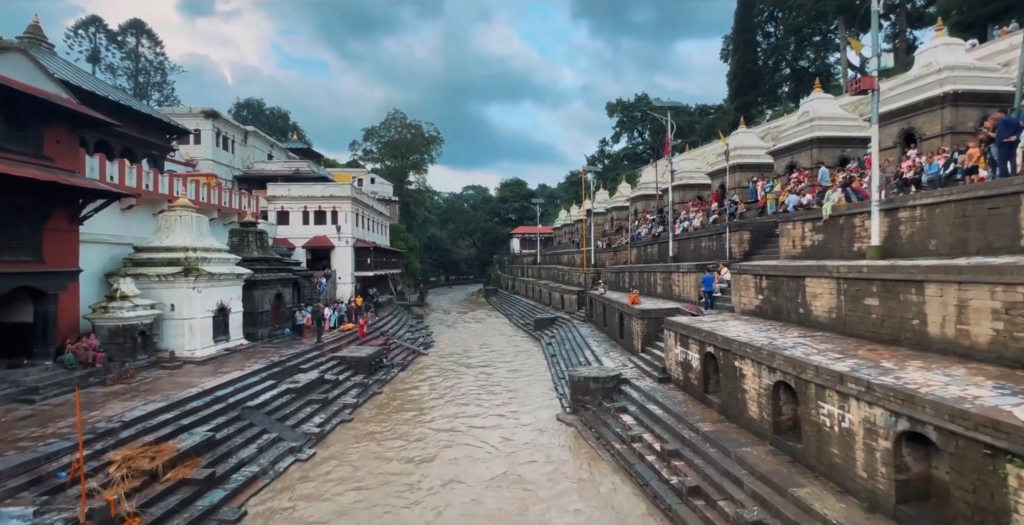
This is one reason environmental and conservation efforts around Pashupatinath — addressing pollution and water flow in the Bagmati — are treated as inseparable from temple preservation itself, rather than a separate civic issue.
What Happens at Pashupatinath Today?
Pashupatinath is not a static monument — it functions as an active place of daily worship, mourning, and festival. On any given day, visitors are likely to see:
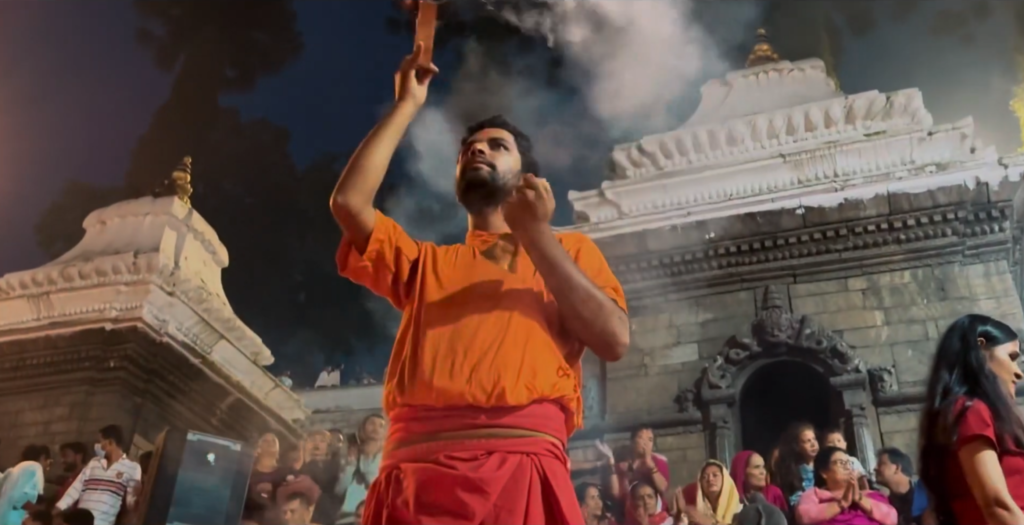
- Morning and evening aarti (light ceremonies), performed with fire, drums, and chanting along the main ghats
- Daily puja rituals conducted inside the sanctum by hereditary priests
- Cremations in progress along the ghats, conducted with quiet ceremony by grieving families
- Sadhus, some affiliated with formal monastic orders and others independent wandering ascetics, seated near the temple, often recognizable by ash-covered skin, matted hair, and simple robes
- Pilgrims and tourists moving through the outer courtyards, since the wider complex — unlike the inner sanctum — is open to visitors of all backgrounds
- Monkeys and deer, treated as sacred and largely undisturbed within the temple grounds
The complex is especially active during specific rituals such as Rudrabhishek, Maha Rudra, and Laghu Rudra ceremonies, and reaches its peak during the annual Maha Shivaratri festival, when several hundred thousand pilgrims — including large numbers from India — gather at the site over several days and nights. See our Rituals & Poojas section for details on Daily Puja, Rudrabhishek, Maha Rudra, and Laghu Rudra.
Can Anyone Visit Pashupatinath?
This is one of the most common questions about the temple, and the answer is nuanced:
- The inner sanctum, where the Pashupati lingam is housed, is restricted to practicing Hindus only. This is a long-standing rule maintained by the temple’s governing trust.
- The broader temple complex — including the outer courtyards, viewing platforms across the river, ghats, and surrounding shrines — is open to visitors of any faith or nationality, generally for an entrance fee applicable to non-Nepali, non-Indian visitors.
- Many non-Hindu visitors view the main temple’s golden roof and the cremation ghats from a designated viewing area on the opposite bank of the Bagmati.
- Modest dress and respectful conduct are expected throughout the complex, particularly near active cremations and ritual areas.
For the complete, detailed policy — including fees, dress code, and photography rules — see our FAQ section: Can Non-Hindus Enter?, Entry Fee, Dress Code, and Photography.
Pashupatinath and UNESCO
Pashupatinath was inscribed by UNESCO in 1979 as one of seven monument zones that together make up the Kathmandu Valley World Heritage Site, alongside locations such as the Durbar Squares of Kathmandu, Patan, and Bhaktapur, Swayambhunath, and Boudhanath. UNESCO’s designation recognizes Pashupatinath as an “extensive Hindu temple precinct” — language that reflects its scale, with the complex covering roughly 246 hectares and containing several hundred individual temples, shrines, ashrams, and inscriptions accumulated over many centuries.
The 2015 Gorkha earthquake damaged some of the outer buildings and monuments within the wider World Heritage Site, though the main Pashupatinath temple and its sanctum were largely unaffected, and restoration work has continued in the years since. For the full UNESCO documentation, criteria, and preservation status, see our UNESCO World Heritage page.
How Pashupatinath Differs From a “Typical” Temple
People encountering Pashupatinath for the first time — especially visitors more familiar with single-structure temples elsewhere — are often surprised by a few things that make it distinct:
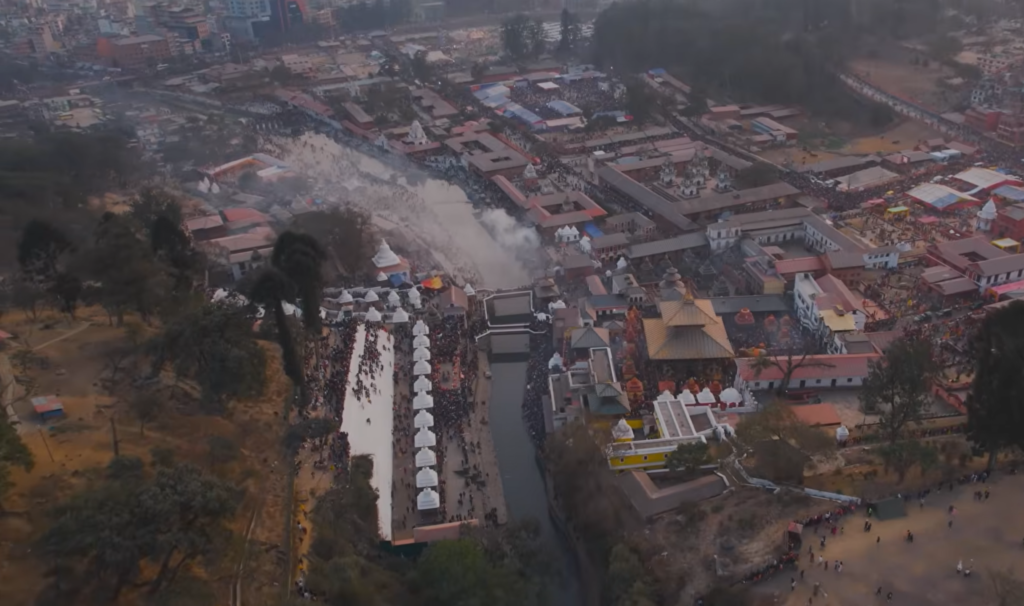
- It is a complex, not a building. Visitors sometimes expect one temple and instead find an entire riverside district with hundreds of shrines.
- Cremation happens in public view. Unlike many pilgrimage sites, active cremations are visible from public viewing areas, which can be startling for visitors unfamiliar with Hindu funerary customs.
- Entry is selectively restricted. The inner sanctum’s Hindus-only policy is unusual compared to many temples worldwide that allow general public entry.
- It combines the sacred and the everyday. Because sadhus live on-site, families cremate loved ones there, and priests perform rituals daily, the temple never functions purely as a historical monument — it remains fully active, every day of the year.
Frequently Asked Questions
Is Pashupatinath a temple or a temple complex?
Both terms are accurate, but “complex” is more precise. Pashupatinath refers to the entire riverside precinct — covering roughly 246 hectares and including more than 500 shrines and temples — not just the single main pagoda structure most people picture.
What god is worshipped at Pashupatinath?
Lord Shiva, in his form as Pashupati (“Lord of All Living Beings”), represented inside the main sanctum by a sacred, reputedly four-faced lingam.
Where exactly is Pashupatinath located?
In Deopatan, on the banks of the Bagmati River, on the eastern edge of Kathmandu, Nepal — a short distance from Tribhuvan International Airport.
Is Pashupatinath a UNESCO World Heritage Site?
Yes. It was inscribed in 1979 as part of the seven-monument-zone Kathmandu Valley World Heritage Site.
Why is Pashupatinath associated with cremation?
Hindu tradition holds that dying and being cremated beside a sacred river aids spiritual liberation. The ghats along the Bagmati at Pashupatinath, particularly Aryaghat, are used daily for cremation for this reason.
Can non-Hindus visit Pashupatinath?
Non-Hindus cannot enter the inner sanctum but can visit the rest of the complex, including viewing areas across the river from the main temple, generally for an entrance fee.
What does the name “Pashupatinath” mean?
It combines Sanskrit roots meaning “living beings” (pashu), “lord” (pati), and an honorific for a deity (nath) — together meaning roughly “Lord of All Living Beings.”
How old is Pashupatinath Temple?
Devotional use of the site likely predates any surviving structure, but the earliest solid textual and inscriptional evidence for a temple here points to roughly the 5th century CE, during the Licchavi period. The current stone-and-copper structure dates mainly from later Malla-era reconstruction, with ongoing renovation across subsequent centuries.
Who administers Pashupatinath Temple today?
Day-to-day rituals are performed by hereditary Bhatta priests, while overall management, conservation, and coordination with UNESCO falls under the Pashupati Area Development Trust (PADT), a Nepal government-affiliated body.
For more short, direct answers, visit our complete FAQ page.
Where to Go Next
This page is meant as a starting point. To go deeper into any specific aspect of Pashupatinath, explore:
- Why is Pashupatinath Famous? — the reputation, records, and recognition behind the temple’s global stature
- Spiritual Importance — the religious meaning behind the site in greater depth
- History — the full recorded timeline from the Kirat era to today
- Mythology — the scriptural and legendary foundations of the site
- Temple Complex — a structural, area-by-area map of the precinct
- Travel Guide — practical information for planning a visit
- FAQ — quick answers to the most common visitor questions
This entry is part of our About Pashupatinath guide, an encyclopedia-style resource covering the essential facts, history, mythology, and rituals of Pashupatinath Temple.
The Pashupatinath is an independent devotional and cultural resource. It is not the official website of the Pashupati Area Development Trust (PADT) or the Government of Nepal. For official temple notices, consult PADT directly.